
Saint-Germain-des-Prés: Where Paris Thought Out Loud
On the Left Bank, a conversation could begin over coffee, wander through philosophy and literature, and leave behind questions a generation would spend years trying to answer.
There is a particular way of discovering Saint-Germain-des-Prés. It begins when you stop treating the neighbourhood as a collection of beautiful addresses and start noticing the conversations its streets have witnessed.
A church stands beside a café. A bookshop occupies a narrow frontage. Behind a terrace of small marble tables, the city continues its business, seemingly indifferent to the extraordinary ideas once debated within these walls.
Yet Saint-Germain has never been merely a place to admire. Its history is one of people gathering to challenge established thinking, to question inherited certainties and to imagine a different relationship between the individual and the world.
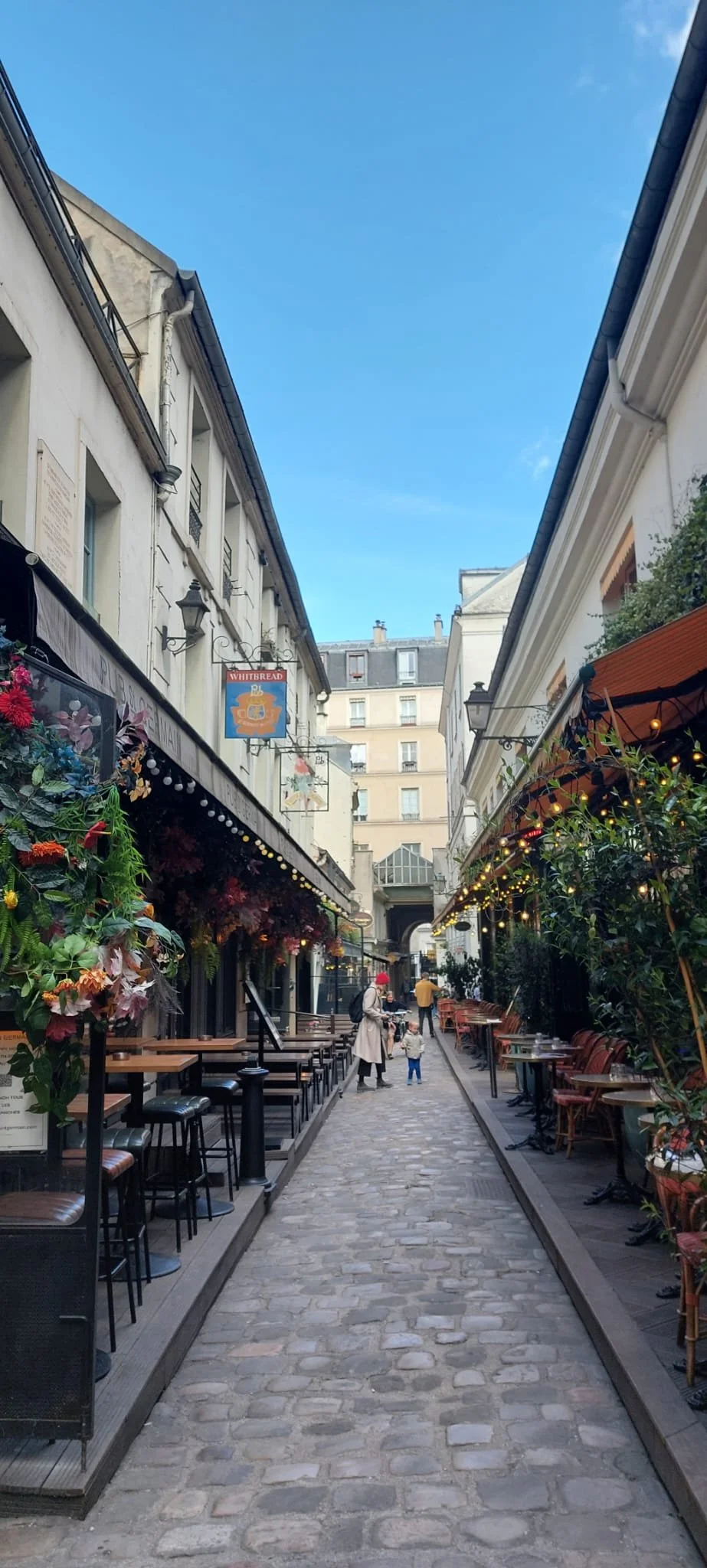
The neighborhood has known religious devotion, literary ambition, artistic experimentation and philosophical rebellion. Each generation has left something behind, not always a monument or a celebrated name, but a way of using the city. Here, an idea did not have to wait for a lecture hall. It could take shape in conversation, encounter resistance at the next table and emerge, hours later, transformed.
Saint-Germain-des-Prés gave intellectual life a Parisian address. More importantly, it gave that life a public stage.
Before the philosophers, there was the abbey
We at Inner Circle Paris strongly recommend beginning your discovery at the Église Saint-Germain-des-Prés.
The neighborhood takes its name from the abbey established here in the sixth century. The surviving church, altered and rebuilt over successive centuries, preserves traces of a city that existed long before Saint-Germain became synonymous with literary cafés and existentialism.
Step into the church and allow your eyes to adjust.
The atmosphere changes. The movement of the surrounding streets gives way to the stillness of stone, columns and painted surfaces. What appears outside to be a familiar Parisian church becomes, inside, a reminder of the extraordinary age of the city beneath the modern one.
This is where the neighborhood's story acquires its proper depth. The intellectual life for which Saint-Germain would eventually become famous did not emerge from an empty stage. It followed centuries in which religious institutions helped shape scholarship, cultural life and the organisation of the city.
The contrast is worth considering. A neighborhood later associated with writers who questioned established beliefs first grew around a religious foundation that helped define Paris for generations.
Saint-Germain has always been capable of holding different worlds together.
The café: Where an idea could find an audience
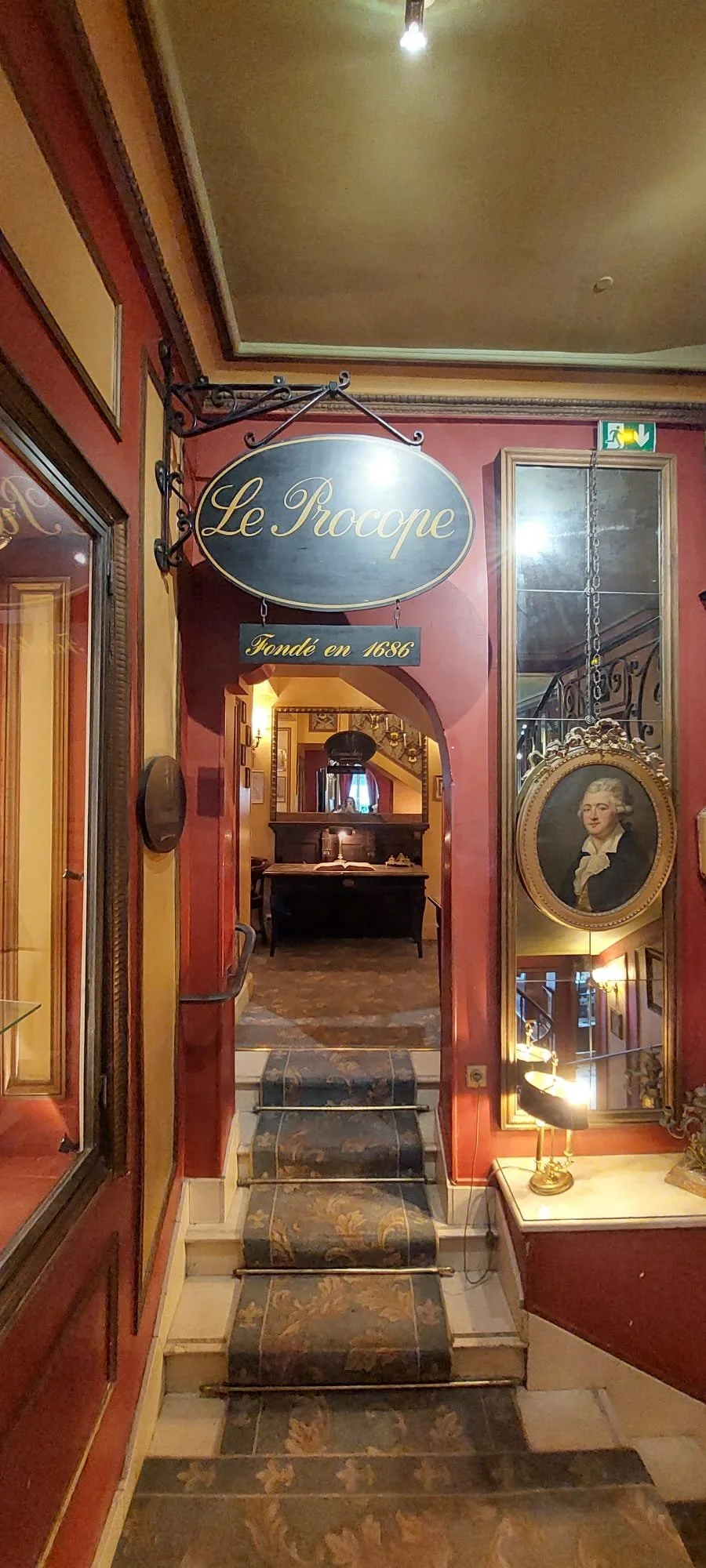
Le Procope
In Saint-Germain-des-Prés, a café has historically offered something that a private room cannot: the possibility of being interrupted.
A writer might arrive with a paragraph that refuses to work. A friend might introduce an unexpected argument. A passing acquaintance might challenge an assumption that had seemed perfectly sound that morning.
The conversation could continue because nobody had to leave when a formal meeting ended. A table could become a temporary office, a debating chamber or a place to observe the theatre of the street.
This was part of the appeal of the literary café. It brought intellectual work into contact with ordinary urban life.
Ideas were not confined to the finished pages of books. They were spoken before they were polished, questioned before they were accepted and carried from one conversation into another.
Saint-Germain's cafés became closely associated with this culture, but their significance extends beyond the celebrated people who visited them. They belonged to a wider network of publishers, theatres, bookshops, artists and writers who made the Left Bank a place of sustained cultural exchange.
The café provided the meeting point. The neighborhood supplied the connections.
Les Deux Magots: A table with a longer memory
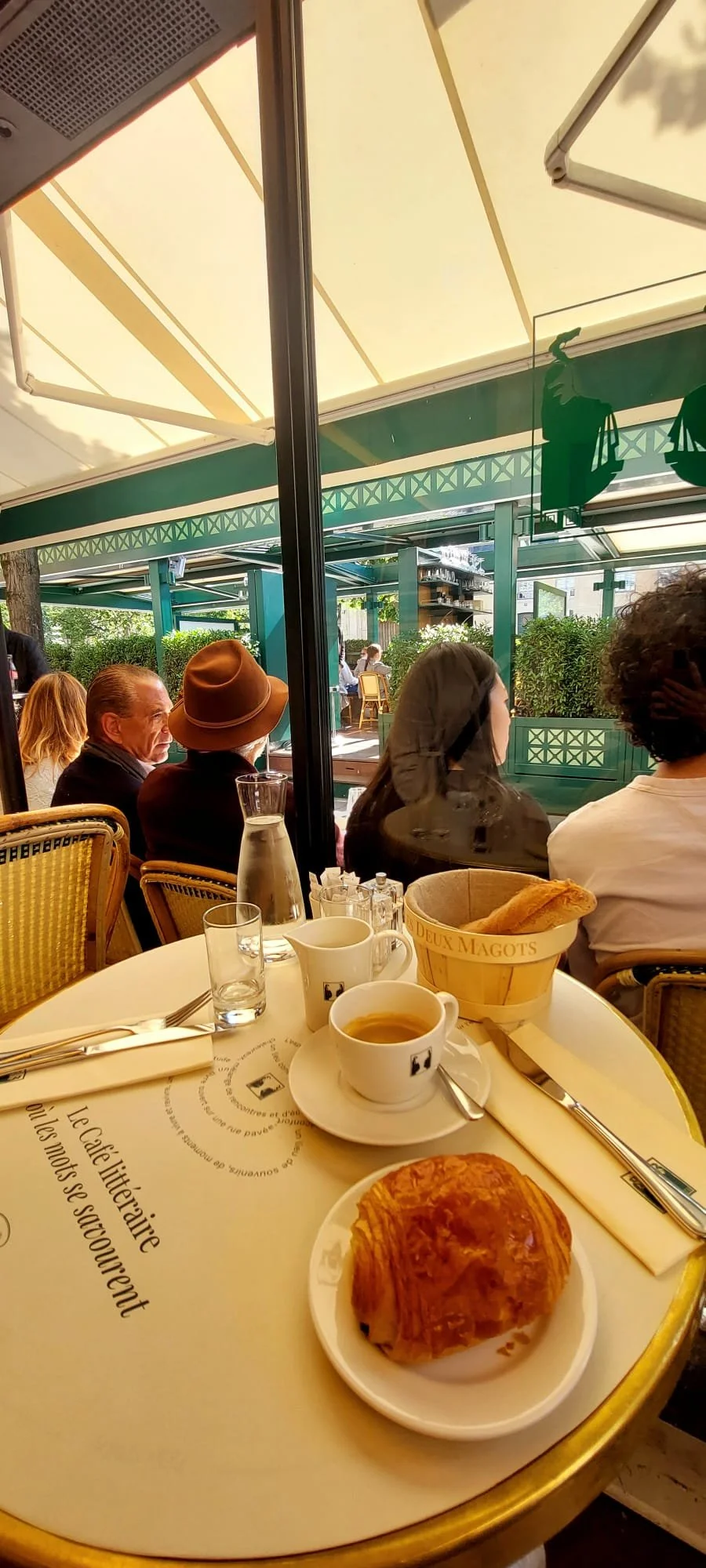
Les Deux Magots
Les Deux Magots is one of the establishments most closely associated with Saint-Germain's literary reputation. Its history as a café dates to 1884, following an earlier life as a novelty shop. Over time, it became a gathering place for writers and artists, and its name entered the cultural history of the Left Bank.
But the most interesting way to approach Les Deux Magots is not to imagine that a famous writer's presence somehow remains suspended above a particular chair. Instead, consider what the establishment represents.
A café can become a cultural landmark when it offers the right conditions for people to meet repeatedly, develop friendships, exchange ideas and become part of a wider intellectual community. Its importance grows through accumulated encounters rather than through one celebrated afternoon.
Today, the terrace offers a view of contemporary Paris: passing pedestrians, conversations in several languages and the everyday choreography of a busy neighborhood. The setting has changed, but the essential pleasure remains. People still come to sit, talk, read and watch the world pass.
Saint-Germain's literary past gives the place another dimension. You are not simply visiting a famous café. You are entering a tradition in which public space has long made room for private thought.
Café de Flore: The street as a study
A short walk away, Café de Flore belongs to the same landscape of intellectual memory.
Its association with twentieth-century writers and thinkers became particularly strong in the postwar years, when Jean-Paul Sartre and Simone de Beauvoir emerged as defining figures of French intellectual life.
Their presence helped establish the image of the café as a place where writing and philosophical reflection could unfold alongside the ordinary business of the city.
There is something revealing about this arrangement.
A traditional study separates the thinker from the world. A café places the thinker inside it. Conversations overlap, strangers pass, the weather changes and the street supplies an endless procession of small observations.
The setting does not guarantee great ideas, of course. What it offers is the possibility of engagement: a chance to test an argument against another person's experience and to discover that a question may be more complicated than it first appeared.
Café de Flore became part of the mythology of Saint-Germain, but the neighbourhood's cultural energy was never confined to its most famous tables. It also depended on less celebrated encounters, on people who worked in publishing and performance, and on the exchange between established figures and emerging voices.
The café was not the whole story. It was one of the places where the story became visible.
Sartre and Beauvoir: The freedom to choose, the responsibility to act
The postwar years gave Saint-Germain-des-Prés an intellectual identity that extended far beyond Paris.
Jean-Paul Sartre and Simone de Beauvoir became associated with existentialism, a philosophical movement concerned with human freedom, responsibility and the ways people create meaning through their choices.
For Sartre, freedom was inseparable from responsibility. To choose was not merely to express a preference; it was to take responsibility for one's actions in a world without simple, ready-made answers.
De Beauvoir brought remarkable depth to questions of ethics, social constraint and human relationships. Her work examined how circumstances and social expectations shape the possibilities available to individuals, particularly women, and what it means to pursue freedom within those conditions.
Their intellectual partnership was distinctive, although neither thinker should be reduced to the other. Each developed a substantial body of work, and their ideas continue to invite discussion and disagreement.
Their association with Saint-Germain helped turn the neighborhood into a symbol of a particular kind of Parisian life: one in which ideas were not merely studied but brought into public conversation.
The image of philosophers talking over coffee is attractive. The substance of their work is more demanding. They asked readers to examine the choices they made, the assumptions they accepted and the responsibilities they might prefer to avoid.
That is a more enduring legacy than any café legend.
Beyond philosophy: A neighborhood of many voices
Saint-Germain's cultural identity was never the property of philosophers alone.
Writers, musicians, performers, publishers and visual artists contributed to its atmosphere. Boris Vian brought together literature, music and an irreverent imagination. Jacques Prévert gave poetry a directness and accessibility that reached far beyond literary circles. Juliette Gréco became one of the defining voices associated with the Left Bank's postwar artistic life.
Their work belonged to different traditions, but their presence reveals something important about the neighborhood. Saint-Germain was not a single intellectual movement with a uniform set of beliefs. It was a meeting place for people working in different forms, pursuing different ambitions and often disagreeing about what mattered.
That diversity helped sustain its reputation. A neighborhood becomes culturally significant not simply when remarkable people live or work there, but when it provides the conditions for different kinds of creativity to encounter one another.
Saint-Germain's cafés, bookshops, performance spaces and publishing connections helped make those encounters possible. Its achievement was not to produce a single Parisian voice. It was to give many voices room to be heard.
A living neighborhood, not a period costume
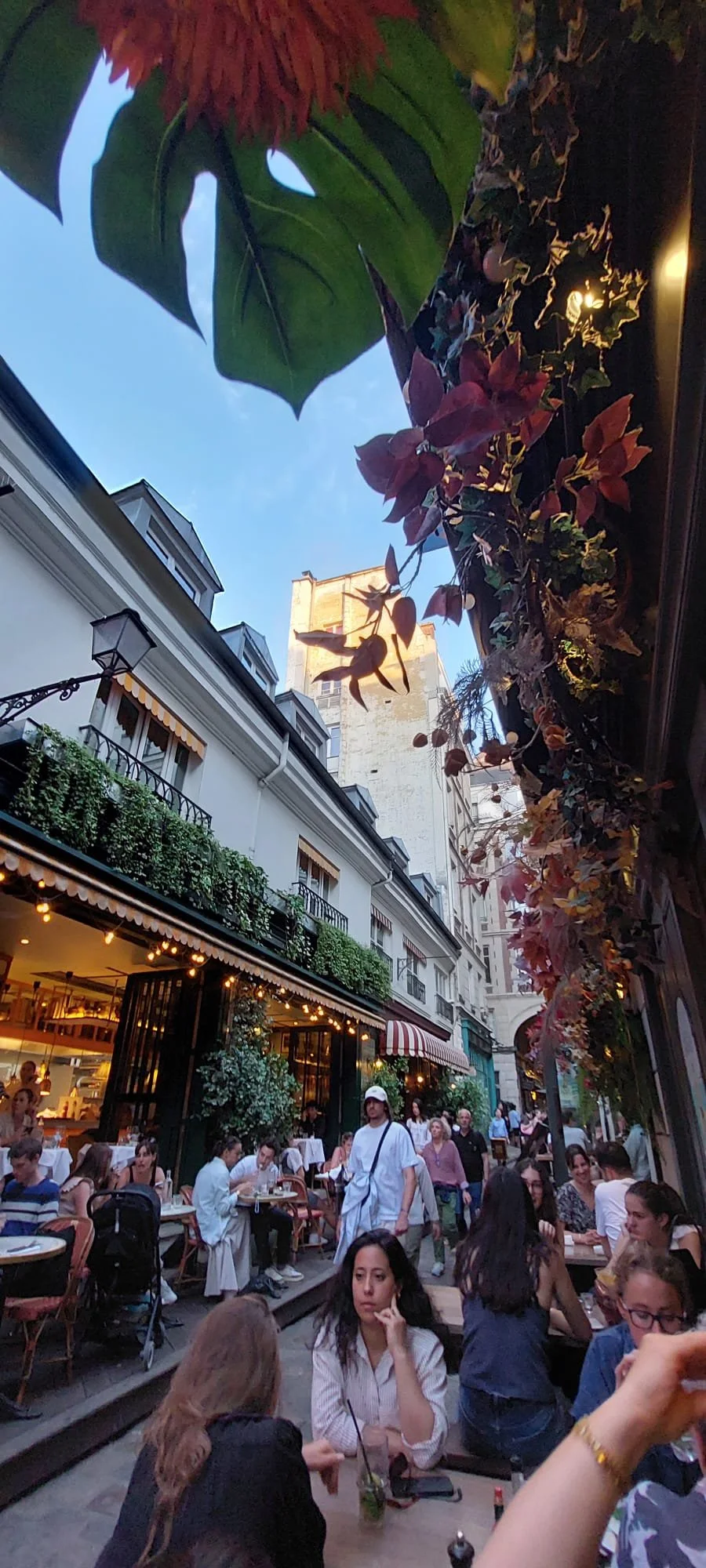
Today, Saint-Germain-des-Prés welcomes visitors drawn by its cafés, galleries, boutiques, restaurants and literary associations. Its reputation is now part of the experience of walking through it.
There is an understandable irony here. A neighbourhood celebrated for questioning conventions can itself become a carefully packaged image of the past.
The temptation is to search for the Paris of Sartre and Beauvoir as though the years since their time were merely an interruption. But a city that remains alive cannot be preserved in one historical moment.
Instead, take the side streets. Look into a gallery. Notice the bookshop windows and the details of the older façades. Observe how residents, shopkeepers and visitors share the same narrow pavements.
The neighborhood's history matters, but so does the life continuing around it.
The church remains a place of worship. The cafés serve contemporary customers. Galleries introduce new work. Businesses change hands, and new generations find their own reasons to gather here.
Saint-Germain is not required to recreate its past to remain interesting.
Its deeper continuity lies in its capacity to accommodate different lives within the same urban fabric.
Where Paris thought out loud
Perhaps Saint-Germain-des-Prés endures because it represents an appealing possibility: that thinking can be part of everyday life.
It need not take place only behind the closed doors of an institution. It can begin with a conversation, an unfamiliar book, a disagreement between friends or a question that refuses to disappear.
The neighborhood's famous cafés are not remarkable simply because important people once sat at their tables. Their lasting significance lies in what they suggest about the relationship between a city and the ideas formed within it.
Architecture creates the setting. Public spaces bring people together. Conversations allow assumptions to be tested, challenged and sometimes transformed.
At Inner Circle Paris, we are drawn to places where history offers more than a sequence of dates or a collection of celebrated names. Saint-Germain-des-Prés invites us to consider how ideas travel: from a private thought into a conversation, from a conversation into a book, and from a book into the wider world.
Begin with the church. Wander past the cafés. Explore the galleries and the smaller streets that give the neighbourhood its character.
And when you find a table that invites you to stay, resist the urge to hurry away.
You may not change the course of philosophy. But you might discover that the most rewarding way to experience Saint-Germain-des-Prés is to participate in the tradition that made it famous: to observe, to question, to listen and to think.
That, after all, is how a neighborhood becomes more than a place on a map.
Inner Circle Paris, Discover Paris Beyond the Ordinary.