
Saint-Germain-des-Prés: Where Paris Thought Out Loud
On the Left Bank, a conversation could begin over coffee, wander through philosophy and literature, and leave behind questions a generation would spend years trying to answer.
There is a particular way of discovering Saint-Germain-des-Prés. It begins when you stop treating the neighbourhood as a collection of beautiful addresses and start noticing the conversations its streets have witnessed.
A church stands beside a café. A bookshop occupies a narrow frontage. Behind a terrace of small marble tables, the city continues its business, seemingly indifferent to the extraordinary ideas once debated within these walls.
Yet Saint-Germain has never been merely a place to admire. Its history is one of people gathering to challenge established thinking, to question inherited certainties and to imagine a different relationship between the individual and the world.
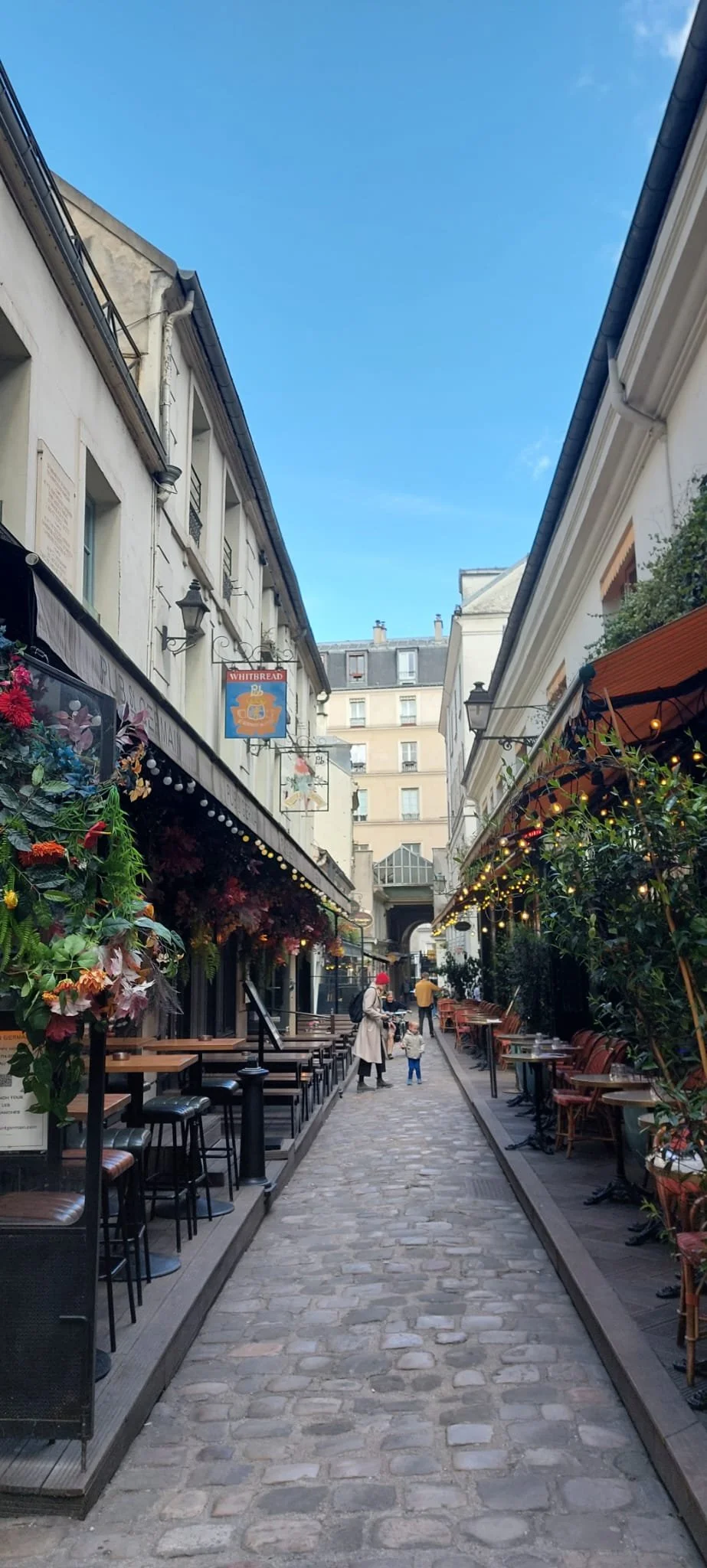
The neighborhood has known religious devotion, literary ambition, artistic experimentation and philosophical rebellion. Each generation has left something behind, not always a monument or a celebrated name, but a way of using the city. Here, an idea did not have to wait for a lecture hall. It could take shape in conversation, encounter resistance at the next table and emerge, hours later, transformed.
Saint-Germain-des-Prés gave intellectual life a Parisian address. More importantly, it gave that life a public stage.
Before the philosophers, there was the abbey
We at Inner Circle Paris strongly recommend beginning your discovery at the Église Saint-Germain-des-Prés.
The neighborhood takes its name from the abbey established here in the sixth century. The surviving church, altered and rebuilt over successive centuries, preserves traces of a city that existed long before Saint-Germain became synonymous with literary cafés and existentialism.
Step into the church and allow your eyes to adjust.
The atmosphere changes. The movement of the surrounding streets gives way to the stillness of stone, columns and painted surfaces. What appears outside to be a familiar Parisian church becomes, inside, a reminder of the extraordinary age of the city beneath the modern one.
This is where the neighborhood's story acquires its proper depth. The intellectual life for which Saint-Germain would eventually become famous did not emerge from an empty stage. It followed centuries in which religious institutions helped shape scholarship, cultural life and the organisation of the city.
The contrast is worth considering. A neighborhood later associated with writers who questioned established beliefs first grew around a religious foundation that helped define Paris for generations.
Saint-Germain has always been capable of holding different worlds together.
The café: Where an idea could find an audience
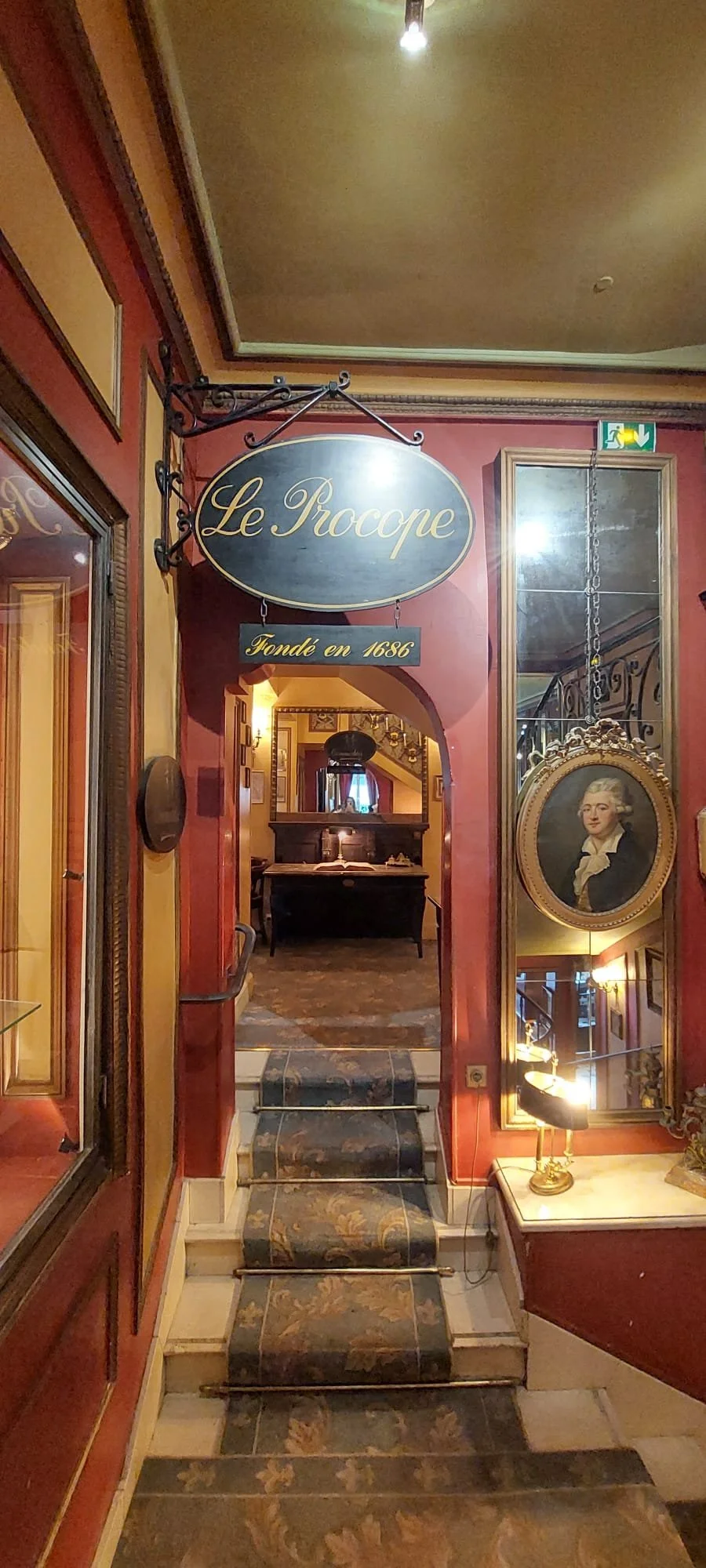
Le Procope
In Saint-Germain-des-Prés, a café has historically offered something that a private room cannot: the possibility of being interrupted.
A writer might arrive with a paragraph that refuses to work. A friend might introduce an unexpected argument. A passing acquaintance might challenge an assumption that had seemed perfectly sound that morning.
The conversation could continue because nobody had to leave when a formal meeting ended. A table could become a temporary office, a debating chamber or a place to observe the theatre of the street.
This was part of the appeal of the literary café. It brought intellectual work into contact with ordinary urban life.
Ideas were not confined to the finished pages of books. They were spoken before they were polished, questioned before they were accepted and carried from one conversation into another.
Saint-Germain's cafés became closely associated with this culture, but their significance extends beyond the celebrated people who visited them. They belonged to a wider network of publishers, theatres, bookshops, artists and writers who made the Left Bank a place of sustained cultural exchange.
The café provided the meeting point. The neighborhood supplied the connections.
Les Deux Magots: A table with a longer memory
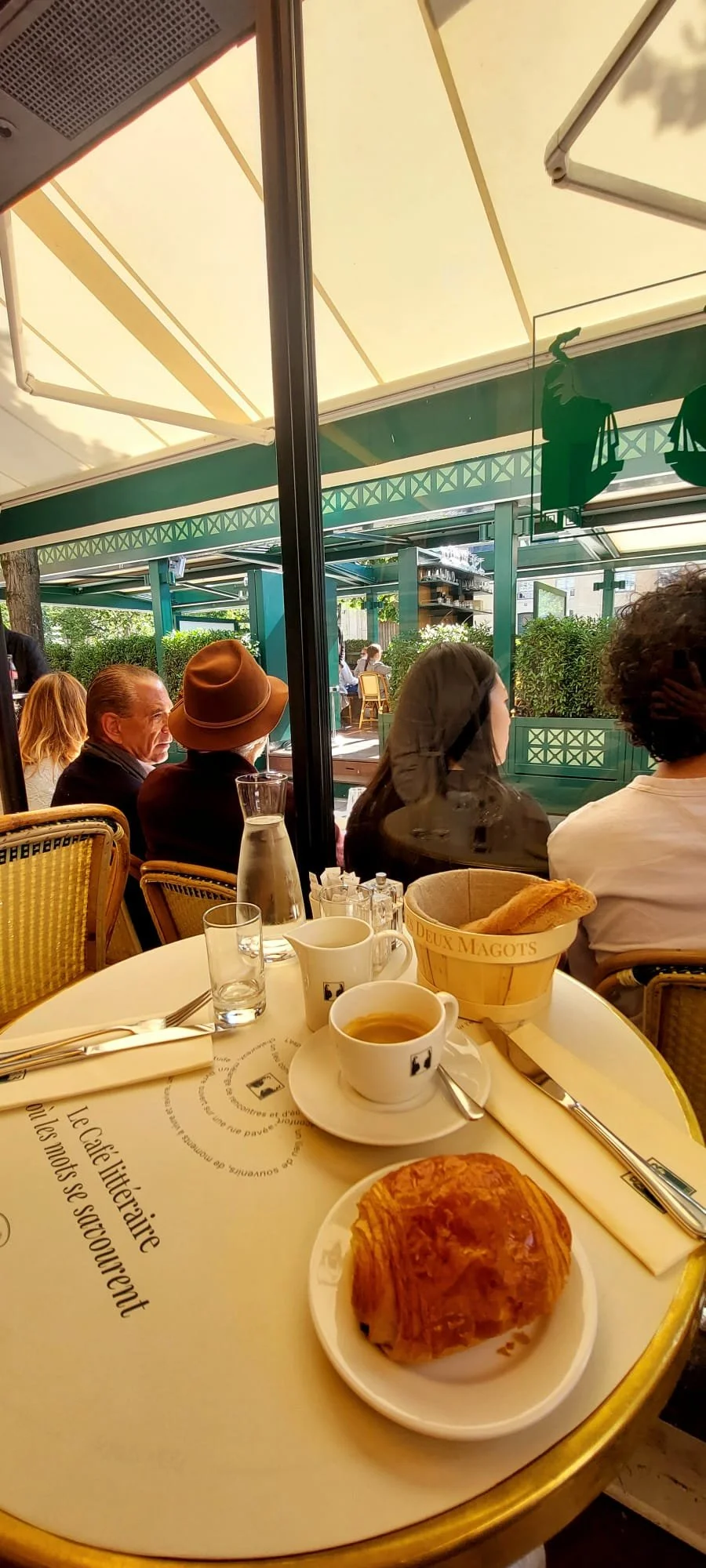
Les Deux Magots
Les Deux Magots is one of the establishments most closely associated with Saint-Germain's literary reputation. Its history as a café dates to 1884, following an earlier life as a novelty shop. Over time, it became a gathering place for writers and artists, and its name entered the cultural history of the Left Bank.
But the most interesting way to approach Les Deux Magots is not to imagine that a famous writer's presence somehow remains suspended above a particular chair. Instead, consider what the establishment represents.
A café can become a cultural landmark when it offers the right conditions for people to meet repeatedly, develop friendships, exchange ideas and become part of a wider intellectual community. Its importance grows through accumulated encounters rather than through one celebrated afternoon.
Today, the terrace offers a view of contemporary Paris: passing pedestrians, conversations in several languages and the everyday choreography of a busy neighborhood. The setting has changed, but the essential pleasure remains. People still come to sit, talk, read and watch the world pass.
Saint-Germain's literary past gives the place another dimension. You are not simply visiting a famous café. You are entering a tradition in which public space has long made room for private thought.
Café de Flore: The street as a study
A short walk away, Café de Flore belongs to the same landscape of intellectual memory.
Its association with twentieth-century writers and thinkers became particularly strong in the postwar years, when Jean-Paul Sartre and Simone de Beauvoir emerged as defining figures of French intellectual life.
Their presence helped establish the image of the café as a place where writing and philosophical reflection could unfold alongside the ordinary business of the city.
There is something revealing about this arrangement.
A traditional study separates the thinker from the world. A café places the thinker inside it. Conversations overlap, strangers pass, the weather changes and the street supplies an endless procession of small observations.
The setting does not guarantee great ideas, of course. What it offers is the possibility of engagement: a chance to test an argument against another person's experience and to discover that a question may be more complicated than it first appeared.
Café de Flore became part of the mythology of Saint-Germain, but the neighbourhood's cultural energy was never confined to its most famous tables. It also depended on less celebrated encounters, on people who worked in publishing and performance, and on the exchange between established figures and emerging voices.
The café was not the whole story. It was one of the places where the story became visible.
Sartre and Beauvoir: The freedom to choose, the responsibility to act
The postwar years gave Saint-Germain-des-Prés an intellectual identity that extended far beyond Paris.
Jean-Paul Sartre and Simone de Beauvoir became associated with existentialism, a philosophical movement concerned with human freedom, responsibility and the ways people create meaning through their choices.
For Sartre, freedom was inseparable from responsibility. To choose was not merely to express a preference; it was to take responsibility for one's actions in a world without simple, ready-made answers.
De Beauvoir brought remarkable depth to questions of ethics, social constraint and human relationships. Her work examined how circumstances and social expectations shape the possibilities available to individuals, particularly women, and what it means to pursue freedom within those conditions.
Their intellectual partnership was distinctive, although neither thinker should be reduced to the other. Each developed a substantial body of work, and their ideas continue to invite discussion and disagreement.
Their association with Saint-Germain helped turn the neighborhood into a symbol of a particular kind of Parisian life: one in which ideas were not merely studied but brought into public conversation.
The image of philosophers talking over coffee is attractive. The substance of their work is more demanding. They asked readers to examine the choices they made, the assumptions they accepted and the responsibilities they might prefer to avoid.
That is a more enduring legacy than any café legend.
Beyond philosophy: A neighborhood of many voices
Saint-Germain's cultural identity was never the property of philosophers alone.
Writers, musicians, performers, publishers and visual artists contributed to its atmosphere. Boris Vian brought together literature, music and an irreverent imagination. Jacques Prévert gave poetry a directness and accessibility that reached far beyond literary circles. Juliette Gréco became one of the defining voices associated with the Left Bank's postwar artistic life.
Their work belonged to different traditions, but their presence reveals something important about the neighborhood. Saint-Germain was not a single intellectual movement with a uniform set of beliefs. It was a meeting place for people working in different forms, pursuing different ambitions and often disagreeing about what mattered.
That diversity helped sustain its reputation. A neighborhood becomes culturally significant not simply when remarkable people live or work there, but when it provides the conditions for different kinds of creativity to encounter one another.
Saint-Germain's cafés, bookshops, performance spaces and publishing connections helped make those encounters possible. Its achievement was not to produce a single Parisian voice. It was to give many voices room to be heard.
A living neighborhood, not a period costume
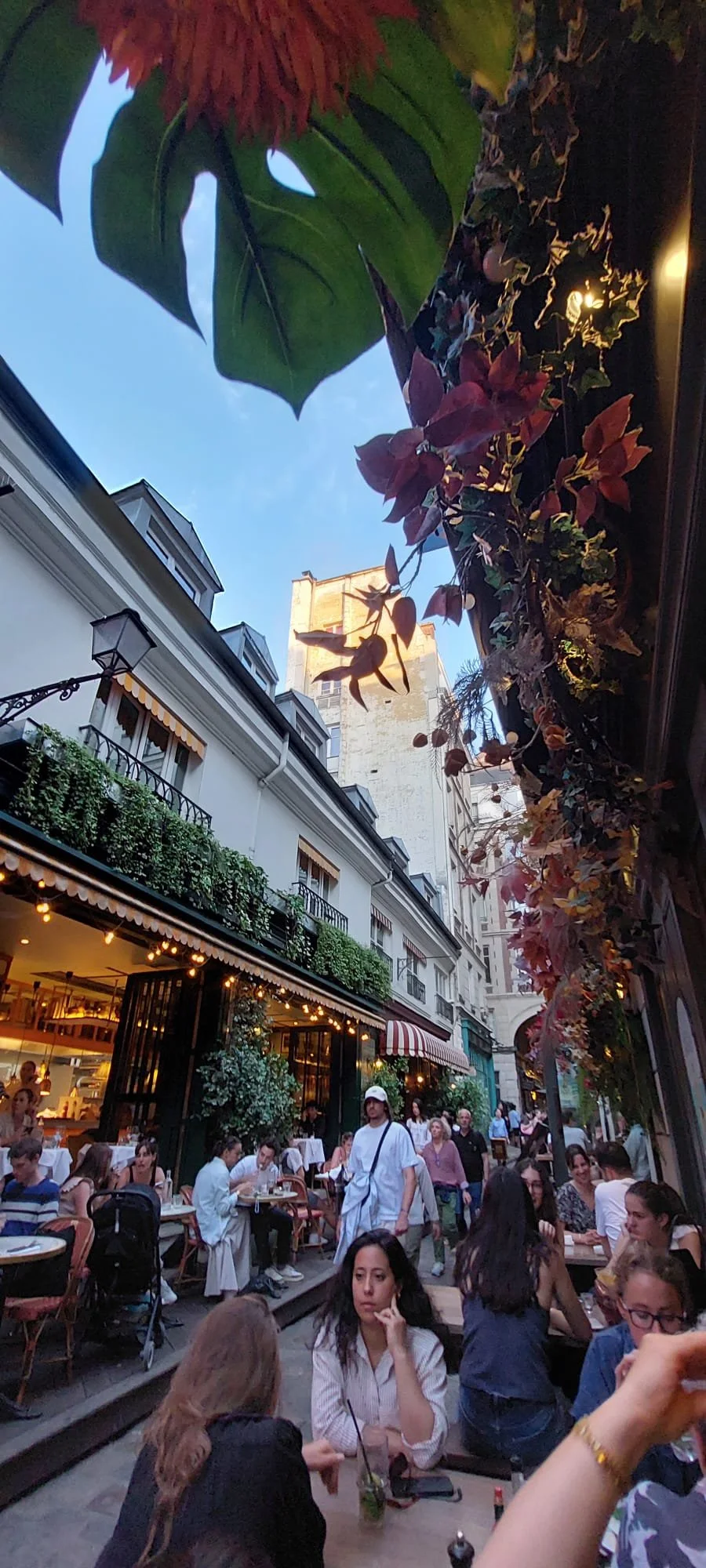
Today, Saint-Germain-des-Prés welcomes visitors drawn by its cafés, galleries, boutiques, restaurants and literary associations. Its reputation is now part of the experience of walking through it.
There is an understandable irony here. A neighbourhood celebrated for questioning conventions can itself become a carefully packaged image of the past.
The temptation is to search for the Paris of Sartre and Beauvoir as though the years since their time were merely an interruption. But a city that remains alive cannot be preserved in one historical moment.
Instead, take the side streets. Look into a gallery. Notice the bookshop windows and the details of the older façades. Observe how residents, shopkeepers and visitors share the same narrow pavements.
The neighborhood's history matters, but so does the life continuing around it.
The church remains a place of worship. The cafés serve contemporary customers. Galleries introduce new work. Businesses change hands, and new generations find their own reasons to gather here.
Saint-Germain is not required to recreate its past to remain interesting.
Its deeper continuity lies in its capacity to accommodate different lives within the same urban fabric.
Where Paris thought out loud
Perhaps Saint-Germain-des-Prés endures because it represents an appealing possibility: that thinking can be part of everyday life.
It need not take place only behind the closed doors of an institution. It can begin with a conversation, an unfamiliar book, a disagreement between friends or a question that refuses to disappear.
The neighborhood's famous cafés are not remarkable simply because important people once sat at their tables. Their lasting significance lies in what they suggest about the relationship between a city and the ideas formed within it.
Architecture creates the setting. Public spaces bring people together. Conversations allow assumptions to be tested, challenged and sometimes transformed.
At Inner Circle Paris, we are drawn to places where history offers more than a sequence of dates or a collection of celebrated names. Saint-Germain-des-Prés invites us to consider how ideas travel: from a private thought into a conversation, from a conversation into a book, and from a book into the wider world.
Begin with the church. Wander past the cafés. Explore the galleries and the smaller streets that give the neighbourhood its character.
And when you find a table that invites you to stay, resist the urge to hurry away.
You may not change the course of philosophy. But you might discover that the most rewarding way to experience Saint-Germain-des-Prés is to participate in the tradition that made it famous: to observe, to question, to listen and to think.
That, after all, is how a neighborhood becomes more than a place on a map.
Inner Circle Paris, Discover Paris Beyond the Ordinary.
Paris at Christmas: The Magic of the Lights, and the Charm Beyond the Crowds
There is a moment in Paris in December, somewhere between the last light of the afternoon and the first lamps of the evening, when the city seems to belong to another century.
The stone facades soften in the fading light. Café windows glow against the cold. A church bell carries across a narrow street, and the smell of warm bread escapes from a neighborhood boulangerie. Somewhere, behind a tall wooden door, a courtyard lies almost entirely still.
And then, as daylight gives way to evening, another Paris awakens.
The great avenues begin to sparkle. Storefronts become elaborate theatrical sets. Trees shimmer beneath thousands of lights, and the city's most celebrated streets take on an almost dreamlike beauty. The excitement is contagious. Paris knows how to celebrate Christmas, and the spectacle can be every bit as enchanting as you imagined.
But there is another side to the season, too.
Beyond the grand illuminations and the places where visitors naturally gather, a quieter Paris continues its everyday life. It is found in the old passages, the small neighborhood squares, the narrow streets of Montmartre, and the cafés where the evening unfolds at its own pace.
The pleasure of Christmas in Paris is that you do not have to choose between these two experiences.
You can marvel at the lights, enjoy the shows, and feel the energy of a city dressed for the holidays. Then, when you are ready, you can turn away from the spectacle and discover a more intimate Paris.
Perhaps the secret to Christmas in Paris is not avoiding the crowds altogether, but knowing when to embrace the magic and when to wander beyond it.
When Paris becomes a spectacle
There is a reason Paris attracts visitors from around the world in December. Few cities understand the art of illumination and theatrical presentation quite so well.
As evening falls, the grand avenues become destinations in their own right. Christmas lights transform familiar architecture, while the great department stores unveil elaborate window displays that blur the line between shopping and performance. Seasonal decorations, festive concerts, and special shows add to the feeling that the entire city has become a stage. The experience deserves to be savored.
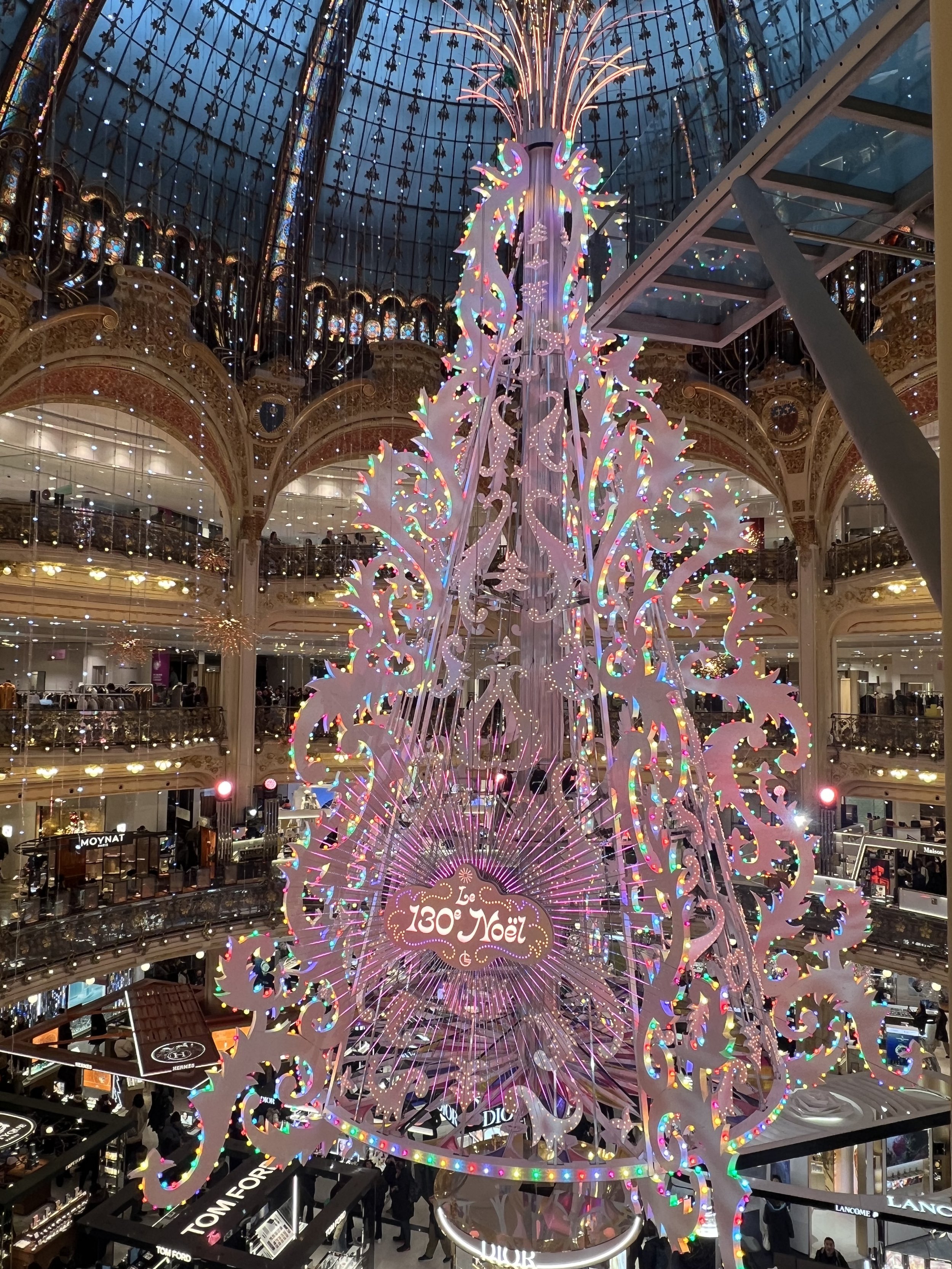
Les Galleries Lafayette
Walk beneath the illuminated trees. Stop to admire a particularly beautiful window. Allow yourself to be swept along by the anticipation of the season. If a Christmas concert, ballet, or other festive performance appeals to you, consider making it part of your stay. Paris offers a rich cultural calendar throughout the winter, and December gives many of its artistic traditions an especially memorable setting.
Of course, the most celebrated places can become busy, particularly on weekends and in the weeks immediately preceding Christmas. But popularity does not diminish their beauty. It simply calls for a little thought about timing.
Visit a major shopping avenue earlier in the day, or choose a weekday evening when possible. Allow extra time to enjoy the displays rather than rushing through them. Check current schedules and booking arrangements for seasonal performances before you travel.
And once you have enjoyed the grand spectacle, resist the temptation to make every remaining hour equally busy. The magic of Paris lies partly in its contrasts. The grand and the intimate, the theatrical and the everyday, the illuminated boulevard and the quiet street around the corner all belong to the same city.
The Paris that appears when you turn away
At Christmas, Paris has two faces.
One is the Paris of the postcards, magnificent, illuminated, and wonderfully theatrical. The other belongs to the streets that have no reason to perform for anyone.
It is found in the old passages where glass roofs soften the winter light, in the small squares tucked between apartment buildings, and along streets where the rhythm of everyday Paris continues almost undisturbed by the season.
A morning walk through the covered passages of Paris offers a different kind of Christmas atmosphere. Beneath their historic glass ceilings, antique shops, bookshops, and little boutiques preserve an intimacy that the grand department stores cannot quite reproduce. Outside, the air may be trenchant with winter cold. Inside, there is the quiet pleasure of wandering without needing to arrive anywhere in particular.
The pleasure is not in seeing everything. It is in having the time to notice something.
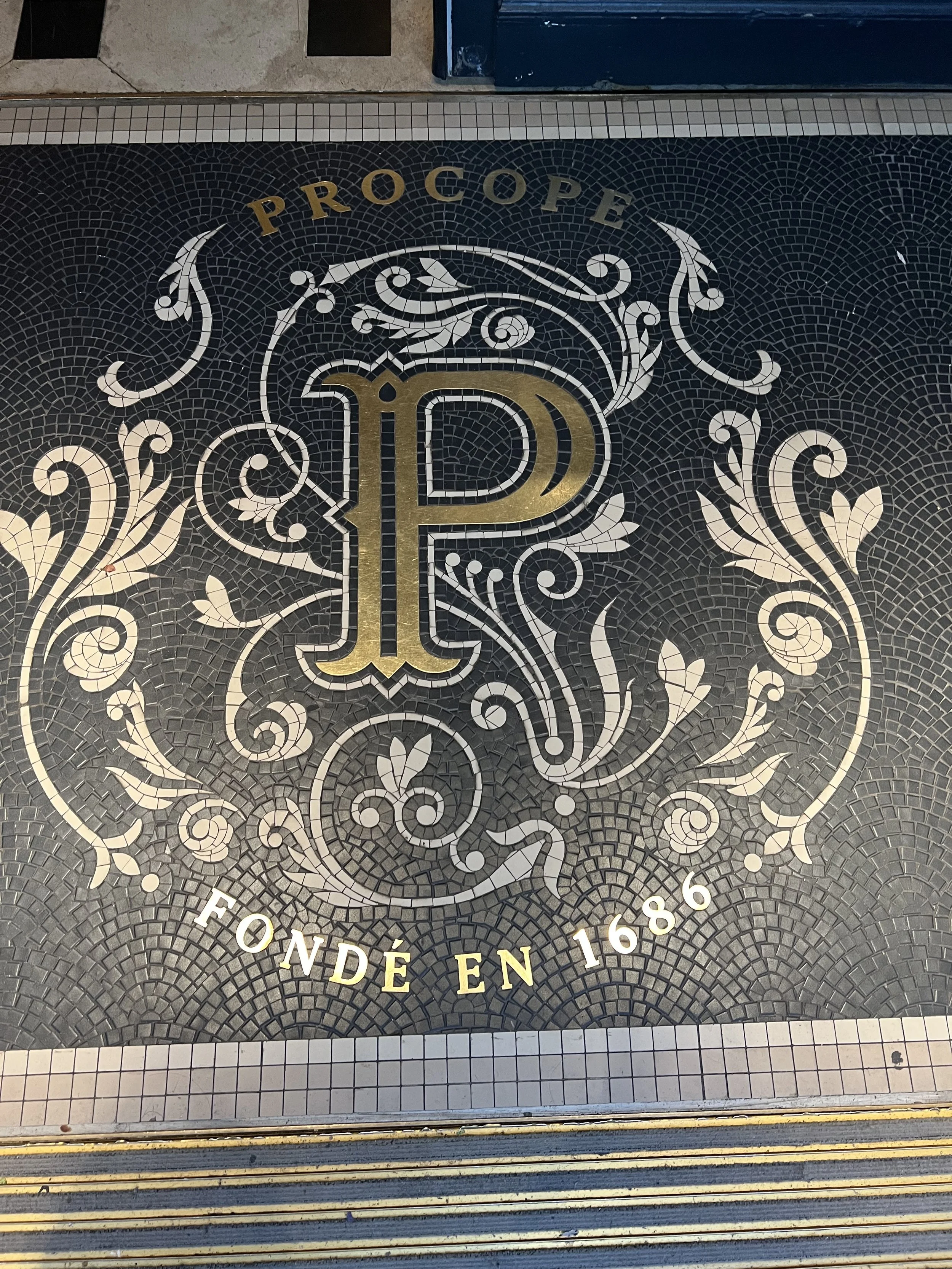
The Mosaic tiles…
A shopkeeper arranging a window. An old mosaic beneath your feet. The reflection of a lamp in the glass. The architecture of a city that has been making room for its inhabitants, their habits, and their small rituals for centuries.
Paris does not need to announce Christmas at every corner. Sometimes, it is enough to let the season find you.
Montmartre, before the city wakes
There are few places in Paris more photographed than Montmartre. We have recently shared a glimpse of this side of the neighborhood on Instagram. But a reel, however beautiful, can only hint at what Montmartre reveals when you are actually there.
Away from its busiest streets and at the right hour, the neighborhood can still feel like a village that happens to overlook one of the world's great cities.
Come early. Before the crowds gather around Place du Tertre, before the cameras and the afternoon excursions, the streets have a different quality. The steps are quieter. The doors of old houses remain closed. The hill belongs, for a little while, to the people who live there.
Take the smaller streets rather than following the obvious route. Look for the old village traces, the gardens in hibernation behind iron railings, and the corners where the past seems less like a story being told to visitors and more like something that has simply refused to leave.
Montmartre is not untouched by time. Nor is it untouched by tourism. Its charm lies in the fact that, beneath the familiar image, a real neighborhood continues to exist.
At Christmas, that distinction matters.
The most rewarding Montmartre is not necessarily the one with the best view. It may be the one where you pause beside an old doorway, hear the sound of footsteps on cobblestones, and briefly forget that you are in a city visited by millions.
And after a quiet morning exploring the neighborhood, you can return to the livelier heart of Paris in the evening, carrying with you a different understanding of the city. The contrast makes both experiences richer.
A different kind of Christmas shopping
There is a particular pleasure in shopping in Paris at Christmas, and there is no need to deny yourself the famous department stores or the celebrated luxury addresses.
Their seasonal window displays can be extraordinary. The scale, imagination, and craftsmanship are part of the city's festive identity. Even those who have no intention of buying anything can find themselves lingering in front of a display, captivated by its detail.
But Christmas shopping in Paris need not end there.
The city is full of smaller discoveries: a bookseller whose shelves invite browsing, an antique shop owner with objects that seem to carry their own histories, a specialty food shop preparing for the holidays, or an independent boutique whose owner knows the provenance of everything in the window.
In these places, shopping becomes a form of conversation.
You may leave with a gift, or with nothing at all. Either way, you have encountered something more personal than a purchase made in the middle of a crowd.
Look beyond the obvious shopping streets. Explore the neighborhood around you. Follow an appealing storefront. Allow yourself to be distracted. Paris rewards curiosity more generously than it rewards speed.
At Christmas, the grand displays may capture your attention, but the smaller shops often capture your imagination. One offers spectacle; the other, a connection to the people and traditions that make the city what it is.
Both are worth discovering.
The churches, the bells, and the meaning of the season
For all its commercial brilliance, Christmas in Paris retains a quieter dimension.
The city's churches, from monumental Gothic interiors to modest neighborhood sanctuaries, offer spaces in which the season can be experienced without the pressure to consume, photograph, or move on.
Step inside respectfully when the doors are open and no service is taking place. Allow your eyes to adjust to the softer light. Notice the wax running down the candles, the stonework, and the silence between footsteps on the paved floors.
At Notre-Dame, the extraordinary achievement of medieval architecture speaks across the centuries. In smaller churches, the experience may be more intimate: a few people sitting in silence, a candle being lit, the sound of a door closing against the winter air.
During Christmas, churches across Paris may hold concerts, services, and seasonal events. Some offer music in settings whose architecture and acoustics make the experience memorable in their own right. Schedules vary, so it is worth checking official parish information before planning a visit.
For those who enjoy the performing arts, a seasonal concert can be a beautiful way to experience the city after dark. For others, simply entering a church for a few quiet minutes may be enough.
Perhaps, in a world that so often seems hurried and unsettled, these moments of reflection have never felt more valuable. Even without a special event, these places offer something that can be difficult to find in a crowded city: a moment in which nothing is expected of you.
You do not have to understand every detail of the architecture or know the history of every saint. You only have to stop.
Outside, the city continues. Inside, for a little while, it seems to breathe more slowly.
When the lights come on
There is no need to avoid the famous Christmas illuminations altogether. On the contrary, they are part of the pleasure of Paris in December, and the city would be diminished without them.
The secret is to choose your moment and give yourself permission to enjoy the spectacle.
Visit the celebrated avenues after dusk. Admire the elaborate window displays. Let the lights reflect in the windows of cafés and in the eyes of people who have come to share the occasion. If the city is lively, embrace that energy. Christmas is, after all, a time for gathering, celebration, and a little wonder.
Then, when you are ready, leave the main avenues behind. Turn into a quieter side street and find a café. Watch the city settle into the evening.
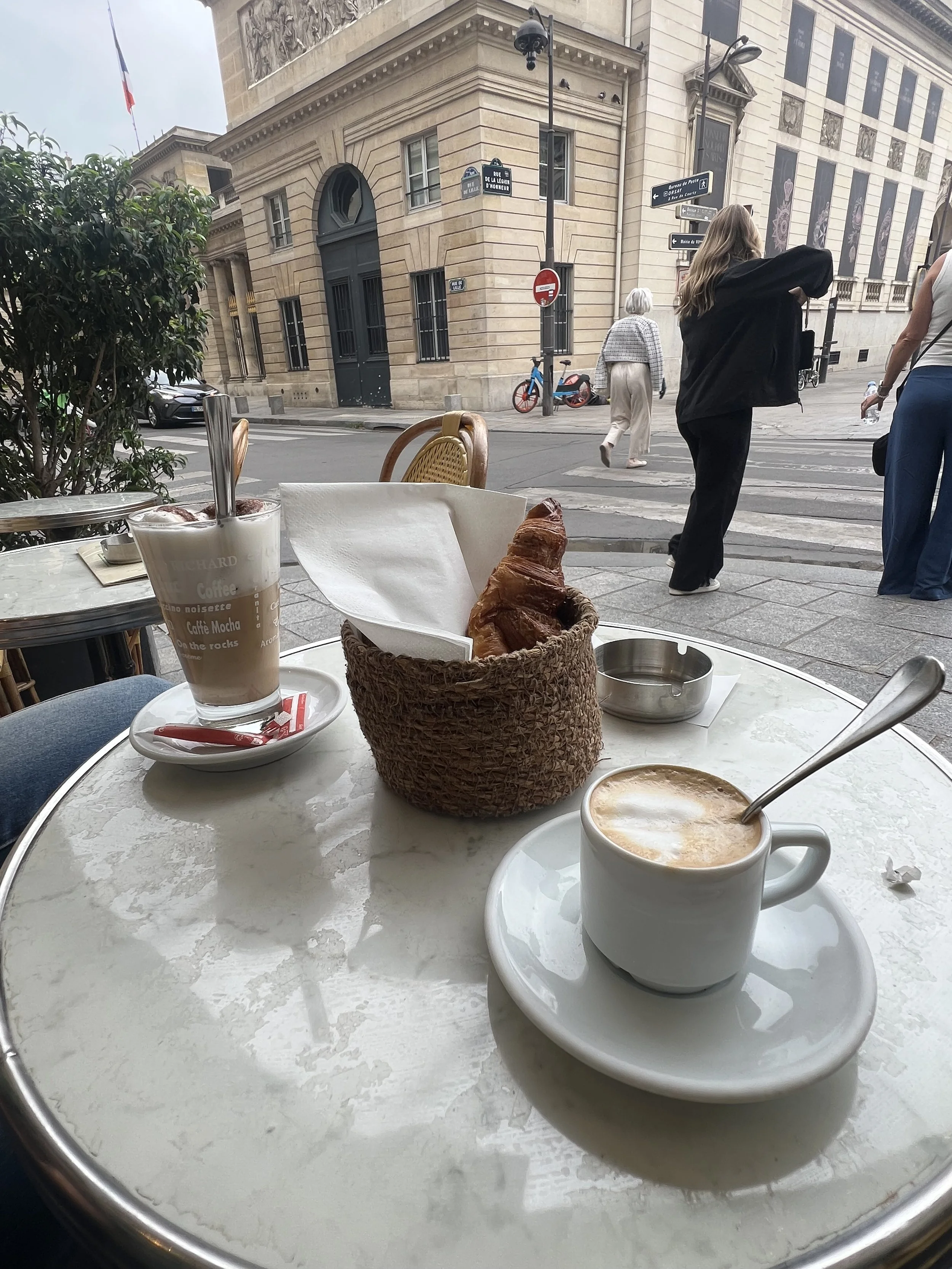
The contrast is what makes the experience memorable. One moment, the city is theatrical, all sparkle and movement. The next, it is intimate again: a warm window, the clink of cups, a couple sharing a small table, the blue of winter dusk lingering above the rooftops.
You begin to understand that these are not two different cities. They are two expressions of the same one.
Paris can be magnificent without being grand, romantic without being staged, and festive without being loud.
You simply need to give it room to show you.
The luxury of having nowhere to hurry
There is a misconception that a successful trip to Paris must be measured by how much you have seen.
At Christmas, that approach can leave you with a remarkable collection of photographs and very little memory of how the city actually felt. And the alternative is not to plan less carefully, but to plan with more intention.
Choose one neighborhood for the morning. Leave time for a long lunch. Reserve an evening for the lights or a performance that excites you. Allow another afternoon for wandering, without feeling obliged to turn every discovery into another destination.
Make room for something that was not on your itinerary. Accept that a small street may be more interesting than the monument you intended to reach. This is not about avoiding the city's great sights. It is about giving them context, and giving yourself the time to appreciate them.
For travelers who value culture, history, architecture, and the pleasure of being somewhere rather than simply seeing it, the quieter side of Paris can be especially rewarding.
A knowledgeable local guide can make that difference even more meaningful, revealing the stories behind a facade, the history hidden in an ordinary-looking street, or the reason a particular corner has remained important to the neighborhood around it.
The experience becomes less about following a route and more about understanding the city.
And that understanding is often what stays with you longest.
Discovering l’autre Paris at Christmas
Perhaps the most beautiful Christmas in Paris is not the one in which you manage to see everything.
It may be the one in which you admire the magnificent illuminations, stand before a department-store window that seems to have stepped out of a dream, or attend a concert that stays with you long after the final note. And then, perhaps, it is the morning you remember most clearly: a quiet walk through Montmartre, the hush of a church, or the unexpected pleasure of finding a little shop you would never have discovered had you followed the crowds.
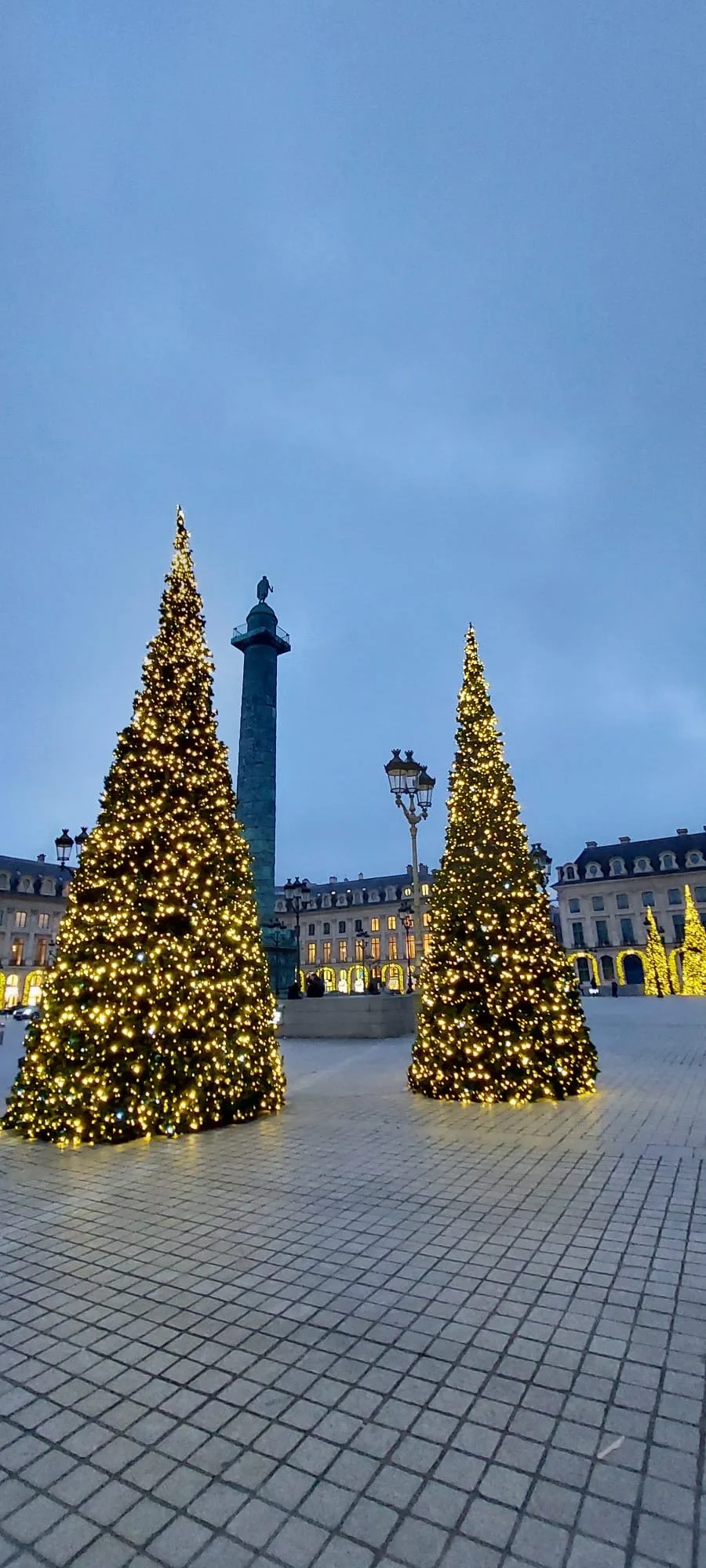
The grand spectacle reminds you why Paris is celebrated around the world. The quieter moments reveal why so many people fall in love with it.
They are reminders that Paris is not a stage set created for visitors, nor a collection of celebrated monuments to be checked off a list. It is a living city, with its own rhythms, rituals, and private corners. Even at Christmas, when the world seems determined to look at the same places, it keeps a little of itself in reserve.
At Inner Circle Paris, our purpose, our joie de vivre is to discover l’autre Paris.
Not a Paris hidden by some grand secret, and certainly not a Paris that asks you to turn away from its celebrated beauty. Rather, the Paris revealed when you look beyond the obvious, when you take the time to understand what you are seeing, and when you allow a neighborhood, a story, or an unexpected encounter to become part of your own experience.
This Christmas, admire the genius of all those lights. Enjoy the shows. Let Paris enchant you with all its brilliance. Then turn down a quieter street. Perhaps you will find a little courtyard, a bookshop, a church filled with candlelight, or a café where the winter evening invites you to stay a little longer. And perhaps, long after the illuminations have faded from memory, it will be that small, unexpected moment that brings you back to Paris.
Because sometimes, the most beautiful gift the city can offer is not another sight to see, but a feeling to take home.
Inner Circle Paris
The Paris Between the Banks
There is a particular kind of Paris that reveals itself only when you cross the Seine.
You may notice it halfway across a bridge. The architecture shifts almost imperceptibly. The rhythm of the street changes. A familiar Paris gives way to another, not better, not more beautiful, simply different.
And for a moment, you understand something about this city that a map can never quite explain. Paris has two banks. But it has never been only two cities.
The Seine runs through its heart, separating the Rive Gauche from the Rive Droite, yet the history of Paris has always been written across that divide. People crossed it. Ideas crossed it. Money crossed it. Art crossed it. Fashion crossed it.
And Paris became Paris in the crossing.
A River, Not a Line
We tend to look at the Seine as a boundary.
On one side, the Left Bank and on the other, the Right.
It is an easy way to orient ourselves. Stand facing the direction of the river's flow and the geography becomes wonderfully simple. But Paris has never been simple.
The Seine was once a working river at the center of daily life, a place of commerce, transportation, labor and exchange. Long before it became the backdrop for romantic walks and evening photographs, it was part of the machinery of the city itself.
The river did not merely divide Paris. It helped it function, and the bridges did something equally important. They made the division temporary. Every bridge offered a passage from one world to another. That may be why crossing the Seine still feels like more than getting from one arrondissement to another.
It feels like entering another chapter.
The Paris of Ideas
The Left Bank acquired its particular mythology slowly.
The presence of the University of Paris and the intellectual life surrounding the Latin Quarter helped establish the southern side of the river as a place of learning and debate.
Centuries later, that identity would acquire a more romantic vocabulary; Booksellers. Cafés. Artists. Writers. Philosophers. The long conversations of Saint-Germain-des-Prés. The studios and cafés of Montparnasse.
The Left Bank became a kind of shorthand for a Paris that preferred questions to answers. But mythology has a way of becoming more powerful than reality. The Left Bank was never simply a city of artists and intellectuals. Nor did everyone who crossed its streets spend the afternoon discussing philosophy over coffee.
Paris was always messier than its legends. That is precisely what makes the legends worth knowing.
The Paris of Ambition
Across the river, another Paris was taking shape.
The Right Bank became associated with commerce, royal power, grand avenues, markets, theaters, finance and the public spectacle of the capital. It was a Paris that looked outward. A Paris of movement, ambition, and display.
Later, it would become the Paris of great department stores, couture houses, elegant hotels and some of the city's most recognizable addresses. The Champs Elysées in July is always replete with enormous crowds for the final stage of the Tour de France.
The grand gesture belongs naturally here. The boulevard. The palace. The façade. The window display. The extraordinary made visible. And yet even this description is incomplete.
Because the Right Bank contains quiet courtyards, medieval streets, intimate neighborhoods and communities whose histories have little to do with grandeur. Le Marais alone makes the old stereotypes difficult to sustain.
Paris has always resisted the categories we create for it.
Then Something Happens Between Them
Perhaps this is where the real story begins. Not on the Left Bank or the Right Bank. But somewhere between the two.
Stand on the Pont des Arts and look in either direction: Behind you, one Paris. Ahead is another. The distance is almost nothing, but the difference can feel enormous.
And then you realize that the two views belong to the same city.
This is one of Paris's quietest tricks. It creates contrasts without requiring separation. The intellectual and the extravagant. The intimate and the monumental. The ancient and the modern. The private and the theatrical.
They coexist within walking distance of one another… sometimes within a few minutes.
The Islands Refuse to Choose
Then there are the islands.
The Île de la Cité sits in the middle of the Seine, carrying some of the deepest layers of Parisian history with it. Notre-Dame, Sainte-Chapelle, the medieval heart of the city.
Here, the distinction between Left and Right becomes almost poetic. The island belongs entirely to neither. It sits between them. And perhaps that is exactly where it should be. Because the oldest Paris was never really about choosing a side. It was about connection.
The city grew around the river, across it and through it. Its history is full of crossings.
The Myth of Choosing
Today, visitors are often invited to choose. Which bank is better? Where should you stay? Which side feels more Parisian? Which one has the better cafés, the better shopping, the better atmosphere?
It is an entertaining question and it is also the wrong one because the magic of Paris is not that one side wins. The magic is that they are different enough to create tension, and close enough to allow you to experience that tension in a single afternoon.
You can begin among the quiet streets of the Latin Quarter, cross the river, pass into the grandeur surrounding the Louvre, continue toward the covered passages, turn another corner and find yourself somewhere entirely unexpected.
Nothing has been lost.
Paris has simply changed its voice.
The Bridges Are Part of the Story
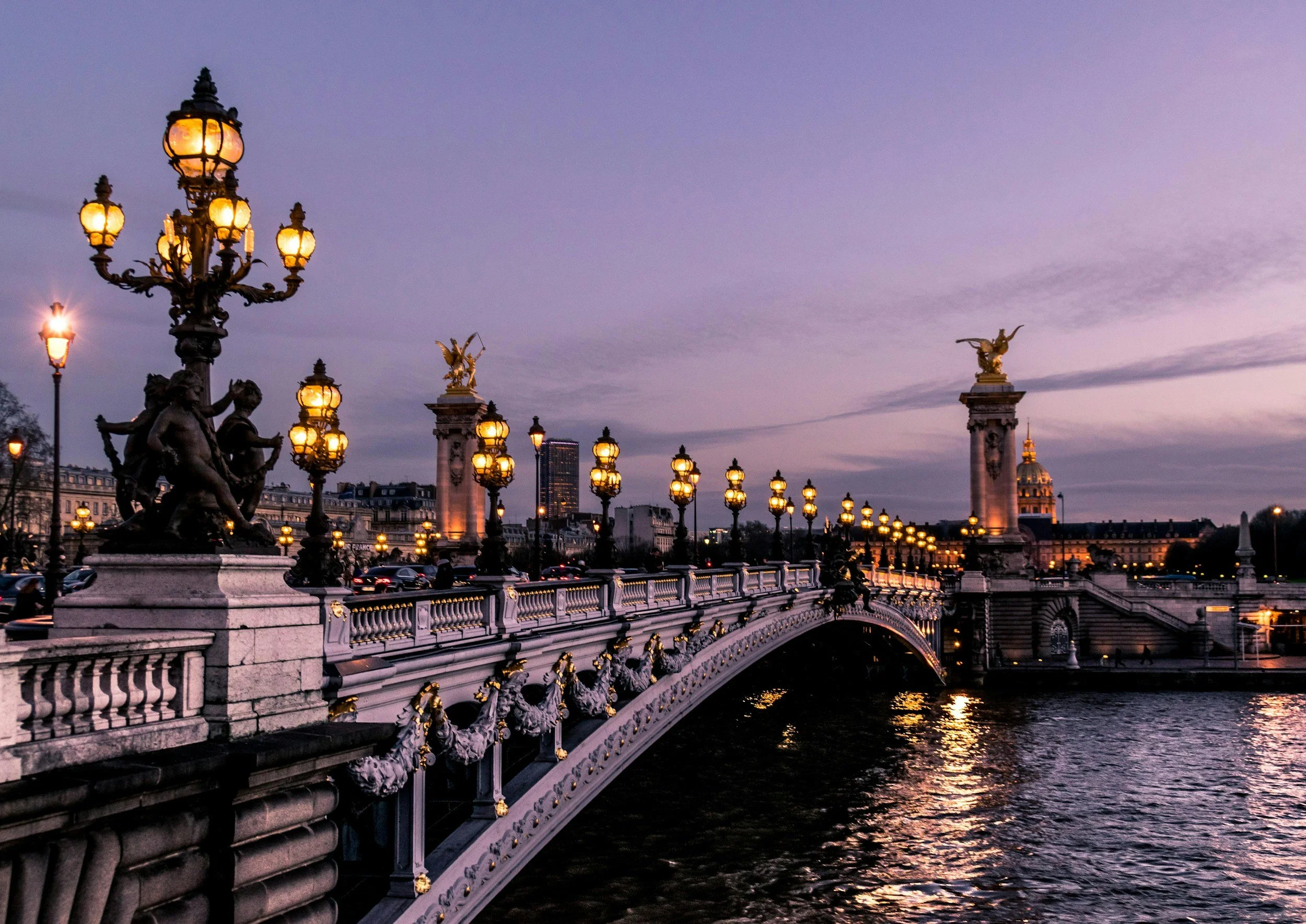
The Ruler of Bridges: Pont Alexandre III
Perhaps we give bridges too little attention as we use them without really seeing them. Yet in Paris, a bridge can be one of the most revealing places in the city. And it is where the perspective opens. Where façades line up and where the river suddenly becomes visible as something more than water. It’s where you can look backward and forward at the same time. And perhaps that is why some of the most memorable moments in Paris happen while walking somewhere rather than arriving somewhere.
You are between destinations. Between neighborhoods and histories. Between one version of Paris and another.
You are, quite literally, in between.
The Paris That Doesn't Announce Itself
The Paris worth discovering is rarely the Paris that needs to announce itself. It may be an architectural detail above a doorway. A courtyard hidden behind an ordinary façade.
A tiny street a few minutes from a celebrated monument, a story that connects a neighborhood to a person who lived there centuries ago, or one bridge crossed thousands of times, suddenly seen differently.
This is the Paris that exists beneath the familiar Paris.
And perhaps that is why the distinction between Left Bank and Right Bank remains so useful, not because it tells us exactly what each side is, but because it gives us a reason to cross from one to the other.
Perhaps There Is No Better Side
The question was never really about which bank is better. It was about what happens when you experience both. Paris does not ask you to choose between thought and beauty, history and modernity, intimacy and grandeur. It offers all of them.
Sometimes within the same block. Sometimes within the same view. Sometimes on opposite sides of the same river. And perhaps that is the great pleasure of Paris: You are never quite finished crossing it.
Discover Paris Beyond the Ordinary
At Inner Circle Paris, we are drawn to this version of the city. Not simply the Paris of monuments, but the Paris of connections.
The story behind the façade, the neighborhood behind the landmark, the detail most people walk past, or the relationship between places that, at first glance, seem to have nothing to do with one another.
Our private experiences are designed for travelers who want more than a list of places to see.They are for those who want to understand why Paris feels the way it does. Because Paris is not a collection of sights. It is a conversation and sometimes, the most interesting part of the conversation is the moment you cross the river.
Paris revealed by someone who knows where to look.
At Inner Circle Paris, our purpose, our joie de vivre, is to discover l'autre Paris, the other Paris. The Paris beyond the ordinary.
Inner Circle Paris
Paris in the Rain: L’ Autre Paris or Is It?
There is a version of Paris that exists beneath blue skies.
It is the Paris of postcards and terraces, of long summer evenings along the Seine, of gardens in bloom and monuments illuminated by late afternoon light and it is beautiful.
But it is not the only Paris. There is another city that appears when the sky turns gray.
The limestone darkens. Windows glow against the weather. The pavement begins to hold the reflections of buildings, streetlights and passing umbrellas. People move a little more slowly. A doorway becomes interesting simply because it is dry.
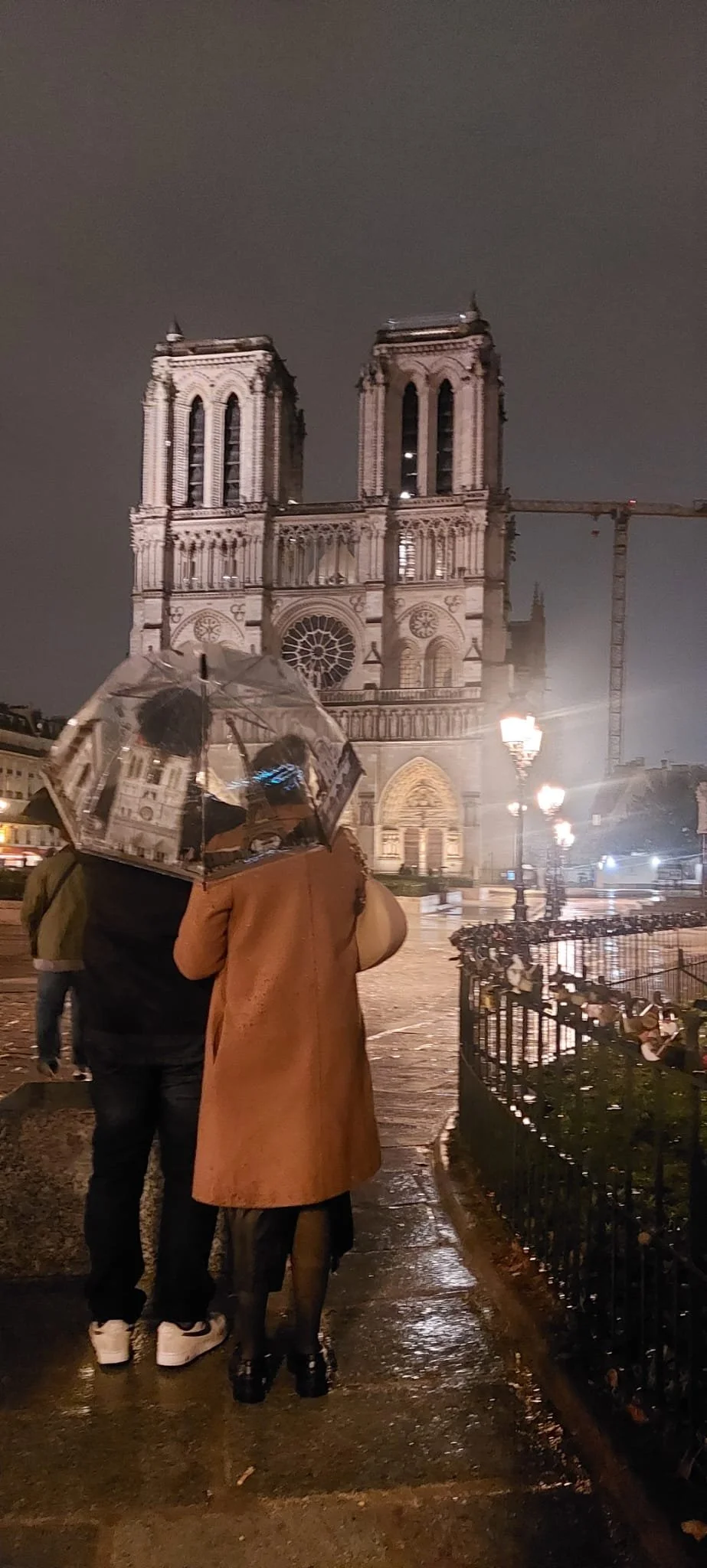
The iconic monuments in the umbrella are sublime
Nothing about the city has really changed. And yet, somehow, everything has. Perhaps that is the secret of Paris in the rain.
The rain doesn't give you a different Paris. It gives you a different way of seeing the one that was already there.
Paris Without the Postcard
Travel encourages us to look for the perfect version of a place. We want the photograph without the crowd. The monument beneath perfect light. The café table on the terrace. The view exactly as we imagined it. But cities are not photographs. They are lived places.
Paris was never meant to be experienced entirely from a carefully composed frame. Its character is found in the transitions between things: the street between two landmarks, the doorway beside the monument, the conversation at the next table, the building you almost didn't notice.
Rain interrupts the postcard. And that interruption can be liberating. Suddenly, you are less concerned with whether the day looks perfect and more interested in what the city is actually doing.
A flower seller pulls a canvas over her stall. A waiter gathers chairs beneath an awning. Someone pauses beneath an old stone archway to answer a telephone. A child jumps over a puddle swinging on dad’s arm, steadying his leather school bag on his back.
A couple shares an umbrella without saying a word, glancing at each other furtively.
None of these moments appears on a conventional itinerary. Yet together, they are Paris.
Rain Changes Your Pace
There is a peculiar pressure attached to visiting a great city. You feel that you should be seeing something. Then something else. And something else after that. The museum. The monument. The neighborhood. The famous street. The photograph. By the end of the day, you may have seen an extraordinary number of things without having really been anywhere.
Rain has a way of challenging that habit. It asks you to slow down.
Not necessarily because you have nowhere to go, but because suddenly the journey itself becomes more noticeable. You begin looking beneath the awnings. You notice the architecture above the shopfronts as you sip on the chocolat chaud (hot chocolate) while clasping the cup with both hands.
You take the longer route because it is more interesting. You stop and pause for five minutes rather than passing something by. Five minutes can be enough. Enough to notice the carved initials above a doorway. Enough to wonder who lived behind those windows. Enough to realize that the building you have walked past twice today is older than the street surrounding it. Enough to begin asking questions.
That is when Paris starts becoming more than a destination.
The Details Come Forward
Bright sunlight can be spectacular. But it can also be overwhelming. Paris has so much visual information that we sometimes see everything at once and, therefore, we see very little.
Rain simplifies the picture. The wet pavement draws the eye downward. The gray sky softens the distance. The trees, the fountain, the courtyard become more pronounced.
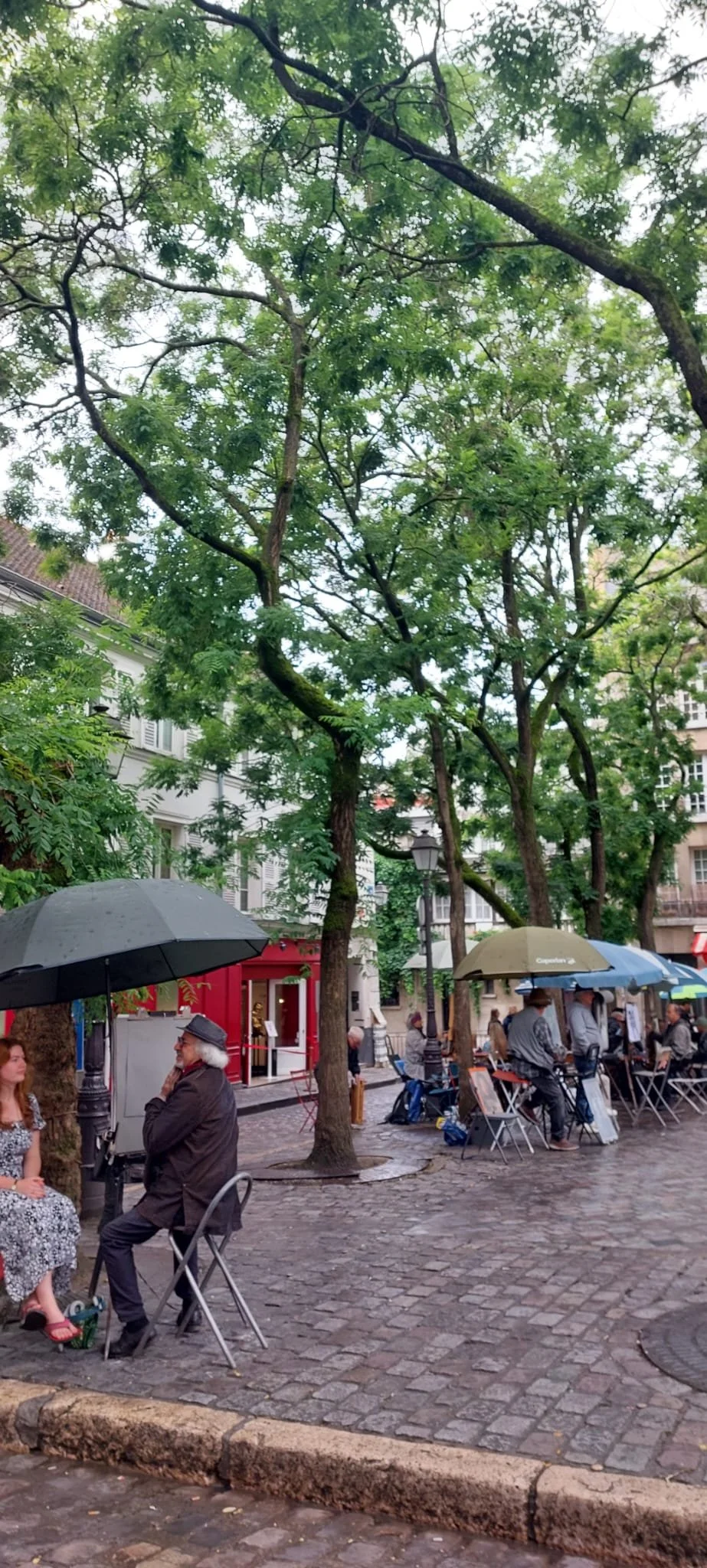
Rain drops on the umbrella never deter the artist… or the selective traveler
The calligraphy of the old sign above a shop catches your attention. The details that normally compete with one another begin to separate. You start looking differently.
And Paris rewards people who look differently.
The city is filled with evidence of the people who came before us: names of building architects of old carved into stone that reveal wealth or ambition, dates above doors, traces of businesses that have disappeared and neighborhoods that have changed beyond recognition.
Much of this is easy to miss when you are moving quickly. Rain gives you an excuse to stop.
The Luxury of Not Being in a Hurry
There is another reason rainy Paris can be particularly appealing to the discerning traveler. It makes something increasingly rare possible: unstructured time.
Not wasted time. Not time between attractions, but time that belongs to you.
A long lunch that becomes longer than expected. A conversation that isn't interrupted by the next scheduled departure. A gallery that deserves another twenty minutes. A street you follow simply because it looks intriguing.
There is a particular kind of luxury in not having to maximize every hour and Paris rewards it. The city has never been particularly good at being rushed. Perhaps we shouldn't ask it to be.
The City Reveals Its Habits
One of the pleasures of rain is watching what happens when Parisians encounter it. The rhythm of the city shifts, but life continues. The bakery remains open. The market still lives. The woman with the weathered face still drags her produce filled grocery cart while covering her hair with her scarf.
The Métro carries people across the city. The streets empty and then fill again.
When you watch how people live in Paris rather than simply what they have come to see, you begin to understand something that no photograph can explain.
Paris is not a museum. It is a city that has been inhabited, argued over, rebuilt, reinvented and loved for centuries.
Perhaps This Is the Paris We Miss
Most visitors arrive knowing what they want to see. That is completely understandable.
The Louvre and Notre-Dame deserve to be seen. Montmartre needs to be walked. The Pont Alexandre III deserves to be crossed. Yes, Paris has earned its reputation. But there is a difference between seeing what is famous and seeing what is there.
The latter requires something else. It requires attention, time, curiosity, and sometimes the willingness to let the weather change the plan.
Rain can take away the certainty of the itinerary. In exchange, it gives you what is possible. You may discover a street you would never have chosen. You may spend longer somewhere than you intended not noticing the raindrops dissipating. You may notice something that wasn't on your list.
You may experience a moment that cannot be reproduced because it depended entirely on that particular afternoon, that particular light, that particular rain.
Those are often the memories that survive. It is learning how to recognize it. That is why the difference between simply visiting Paris and truly experiencing it is rarely about how many places you see.
It is about how you look.
And This Is Where a Guide Changes Everything
A great guide does not simply protect you from the rain. They change what you notice while you're in it.
Stephanie narrates the story of that one Montmartre street where a beloved French singer lived and left behind her a revered bust.
Tiffen smiles knowing that one chocolatier atelier around the corner will leave lifelong lasting memories of smells and tastes while the rain clip-clops
Sarah’s steps through the gardens of Versailles suddenly leave a deep imprint in the small gravel alleys leading to the Latona Fountain as she gleefully recounts how king Louis XIV used Greek mythology for the “benefit” of his opponents.
Astrid gingerly points to the arc de triomphe where the beloved 1950’s American movie star posed dramatically while playing or perhaps wrestling with a large bunch of colorful balloons.
Umbrella in hand, Elise eagerly shares the profound neighborhoods’ history that become more interesting when you leave the main avenue.
When the weather changes, that knowledge becomes even more valuable. Perhaps the rain has made a particular neighborhood quieter. Perhaps a museum deserves another hour. Perhaps there is a street you would never have chosen that suddenly looks extraordinary beneath a gray sky. Perhaps the best decision is simply to slow down. That is not something a checklist can tell you. It takes someone who knows the city.
Paris Doesn't Need to Perform
There is something wonderfully democratic about rain. It doesn't care whether you are visiting Paris for the first time or have lived here for fifty years. It falls over the famous monuments as well as the ordinary apartment buildings. It falls on the grand boulevard and the little side street. On the palace and the neighborhood café. And perhaps that is why rainy Paris feels less like a performance.The city doesn't have to look perfect.
It simply exists.
The limestone darkens. The umbrellas appear. The Seine moves beneath the bridges. Someone lights a lamp. Someone opens a door. Someone keeps walking. And suddenly you realize that you are not looking at the Paris you came to photograph.
You are looking at Paris itself.
Maybe the Rain Is the Point
At Inner Circle Paris, we believe the most memorable experiences rarely come from simply collecting famous places. They come from understanding them. From knowing what you are looking at. From noticing what other people walk past. From having enough time to follow a story when it leads somewhere unexpected.
Rain encourages exactly that kind of experience. It slows the city without stopping it and softens the familiar without making it unrecognizable.
It asks you to look closer. And perhaps that is why we have come to think of rainy Paris not as a lesser season, but as one of its most revealing.
The postcard disappears.
And what remains is Paris. Unhurried. Unpolished. Unexpected and alive. Perhaps that is the Paris worth discovering.
At Inner Circle Paris, our purpose, our joie de vivre, is to discover L' Autre Paris.
The Other Paris. The one that has been there all along. If this is the Paris you came hoping to find, don't simply follow an itinerary. Come discover L’ Autre Paris with us.
Inner Circle Paris
She Came to Paris to Dance: The American Who Became French
There is a familiar story about Americans in 1920’s Paris.
They came looking for something they could not quite find at home. Writers filled the cafés of the Left Bank. Artists gathered in Montparnasse. Books crossed the Atlantic. Jazz entered Parisian nightlife. The city became a meeting place for Americans who wanted to write, paint, experiment, escape convention, or simply experience a different way of living.
Ernest Hemingway became one of the most famous faces of that world. F. Scott Fitzgerald passed through it. Gertrude Stein built her own remarkable artistic circle. Sylvia Beach created a literary home for English-language writers on the rue de l'Odéon.
They came to Paris.
But there was another American who came to Paris during those extraordinary years and followed a very different path.
She did not simply live here. She did not merely perform here. She did not remain an American looking in from the outside. She became French.
Her name was Joséphine Baker.
The American Arrives in Paris
She was not yet 20 years old In 1925 when Joséphine Baker arrived in France. Paris was in the midst of the Années folles, the period of cultural experimentation and nightlife that followed the First World War. Jazz, dance, cinema, fashion, cabaret, and new forms of entertainment were changing the atmosphere of the city.
Baker arrived as a young American performer with an extraordinary physical presence and a style that Paris had never quite seen before. On October 2, 1925, she appeared at the Théâtre des Champs-Élysées in La Revue Nègre and the response was instantaneous.
Her performance became one of the sensations of Jazz Age Paris.
But there is an uncomfortable complexity to that success.
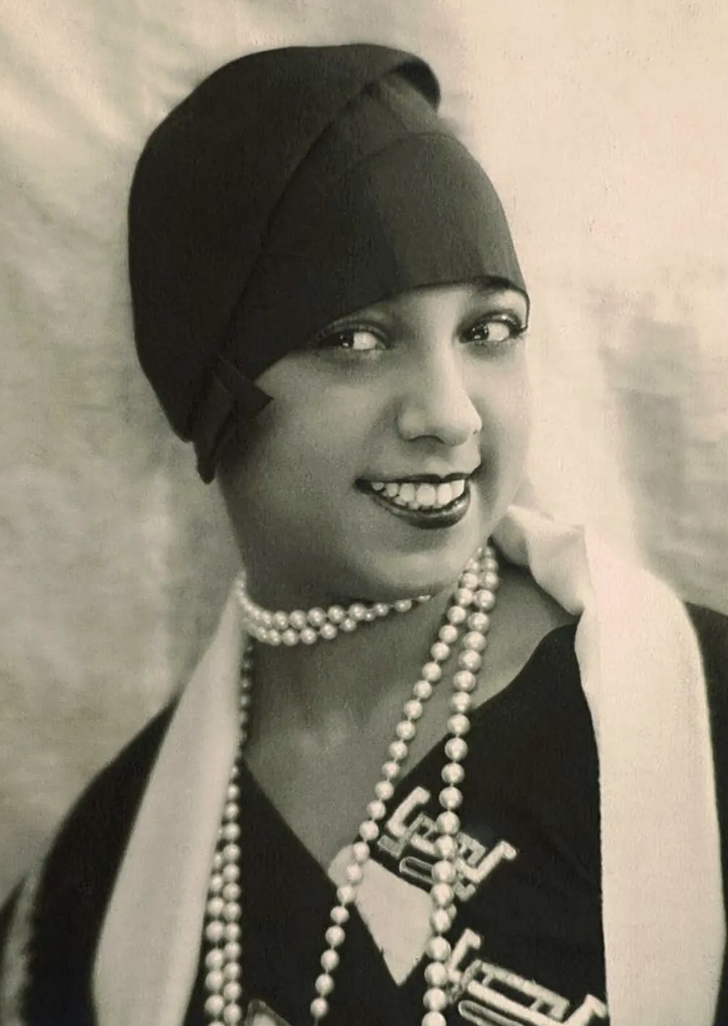
(Non-copyrighted picture of Josephine Baker 1930 from Picryl Library)
The French fascination with Baker was partly shaped by exotic stereotypes about Black Americans and colonial culture. Baker understood the expectations being placed upon her and, in her performances, she often exaggerated, distorted, and played with those expectations. The Élysée's historical account of her life describes how she used comedy and physicality to undermine some of the very stereotypes being projected onto her.
That contradiction would follow her throughout her career. Paris opened doors for her, but the doors did not open into a completely uncomplicated world.
She Didn't Just Perform in Paris
After La Revue Nègre, Baker's career in France expanded rapidly. She performed at the Folies-Bergères and the Casino de Paris. She became a singer and actress as well as a dancer. She appeared in films, including Zouzou, alongside Jean Gabin. (famous French actor)
She became one of the most recognizable performers in Europe. And something else was happening. She was learning France. The language. The culture. The rhythms of Parisian life. The audiences. The music. The theater. The public imagination.
She was no longer simply an American entertainer appearing in Paris. She was becoming part of the French cultural landscape. The French National Library continues to document the importance of her Paris performances, including her celebrated appearance at the Folies-Bergères in 1926.
And that distinction matters.
Many Americans of the Jazz Age experienced Paris as expatriates. Josephine increasingly experienced it as home.
Two Ways of Being American in Paris
This is where Joséphine Baker changes the story of the American Left Bank.
Hemingway's Paris is often remembered through his writing. Fitzgerald's through his social world. Sylvia Beach's through books and literary friendships and the American expatriate experience was, in many cases, about maintaining a relationship with America while living somewhere else.
Baker's story eventually went into a different direction. She was not simply an American who happened to live in France. She became an American-born French citizen.
In 1937, she married Jean Lion and became a French citizen. The French presidency later described her as an American who had chosen France and made that choice part of her identity and public life. And this was not merely a legal change. Her relationship with France became increasingly profound.
Later on, In a famous expression of that attachment, Baker described Paris as her country. It is difficult to imagine a more revealing contrast with the conventional expatriate story. Some Americans came to Paris to discover themselves. Baker came to Paris, and eventually made Paris part of herself.
The City Gave Her a Stage
There is irony in Baker's story. France gave her opportunities that the United States of her youth had denied her. Born in St. Louis in 1906, Baker grew up under the realities of racial segregation in America. The French presidency's account of her life recounts the poverty, discrimination, and violence she experienced before becoming a performer.
Paris offered something different. It was not equality in every sense, but rather a stage, an audience, a career, and eventually a place in French public life.
Her transformation therefore cannot be reduced to the romantic idea that Paris simply “accepted” her. Paris was complicated, France was complicated and so was she. She succeeded partly because she was able to turn the expectations placed upon her into something uniquely her own.
She took the image others wanted to see and made it part of a performance that belonged to her. That ability, to transform expectation into identity, became one of the defining characteristics of her career.
Then the Story Changed
The Jazz Age eventually gave way to a much darker Europe. The glamorous Paris of the 1920s could not survive unchanged into the 1940s. And Baker's relationship with France changed.
During the Second World War, she did something that separated her even more dramatically from the image of the glamorous American performer.
She became involved with the French Resistance.
According to the Élysée, she transmitted confidential information, helped the Resistance, supported Free French forces, and used her international travel and celebrity as part of her wartime activities. She was subsequently awarded the Médaille de la Résistance and, later, the Croix de guerre and the Légion d'honneur. That in itself is extraordinary.
The young American who had arrived in Paris as a dancer was now risking her life for France and the stage had become something else. France was no longer simply the country in which she had found artistic freedom. It had become a country she was willing to defend.
From Performer to Citizen
That is perhaps the most important distinction between Josephine Baker and the more familiar American expatriates of the 1920s. She did not remain permanently outside French society, looking at it with an American perspective. She entered it as she took French citizenship.
She participated in French public life. She served France during the war and she continued to live between France and the United States while maintaining a profound attachment to both countries.
And she never stopped being American (That is what makes her story so interesting.) Her identity was not a simple replacement of one nationality with another. She became both.
American by birth. French by choice. Parisian by attachment. And, eventually, a figure within France's national historical memory.
The American Who Became Part of France
In 2021, France gave Baker one of its most extraordinary honors.
She entered the Panthéon. The French presidency described her as “American and French” and emphasized that she had chosen France, fought for its freedom, and made the country part of her life's work.
The symbolism is rather difficult to miss. The Panthéon is where France honors figures it considers significant to the nation's history. And Joséphine Baker entered not because she had been born French but because she had come from somewhere else.
Her story therefore belongs to a much larger Parisian tradition. Paris has always attracted outsiders, artists, writers, musicians, thinkers, and revolutionaries.
People arrive speaking another language and gradually discover that the city has given them a new way of seeing the world. Some stay for a season. Some stay for a career. Some leave. And a very few become part of the history of France itself.
Joséphine Baker belongs to that last category.
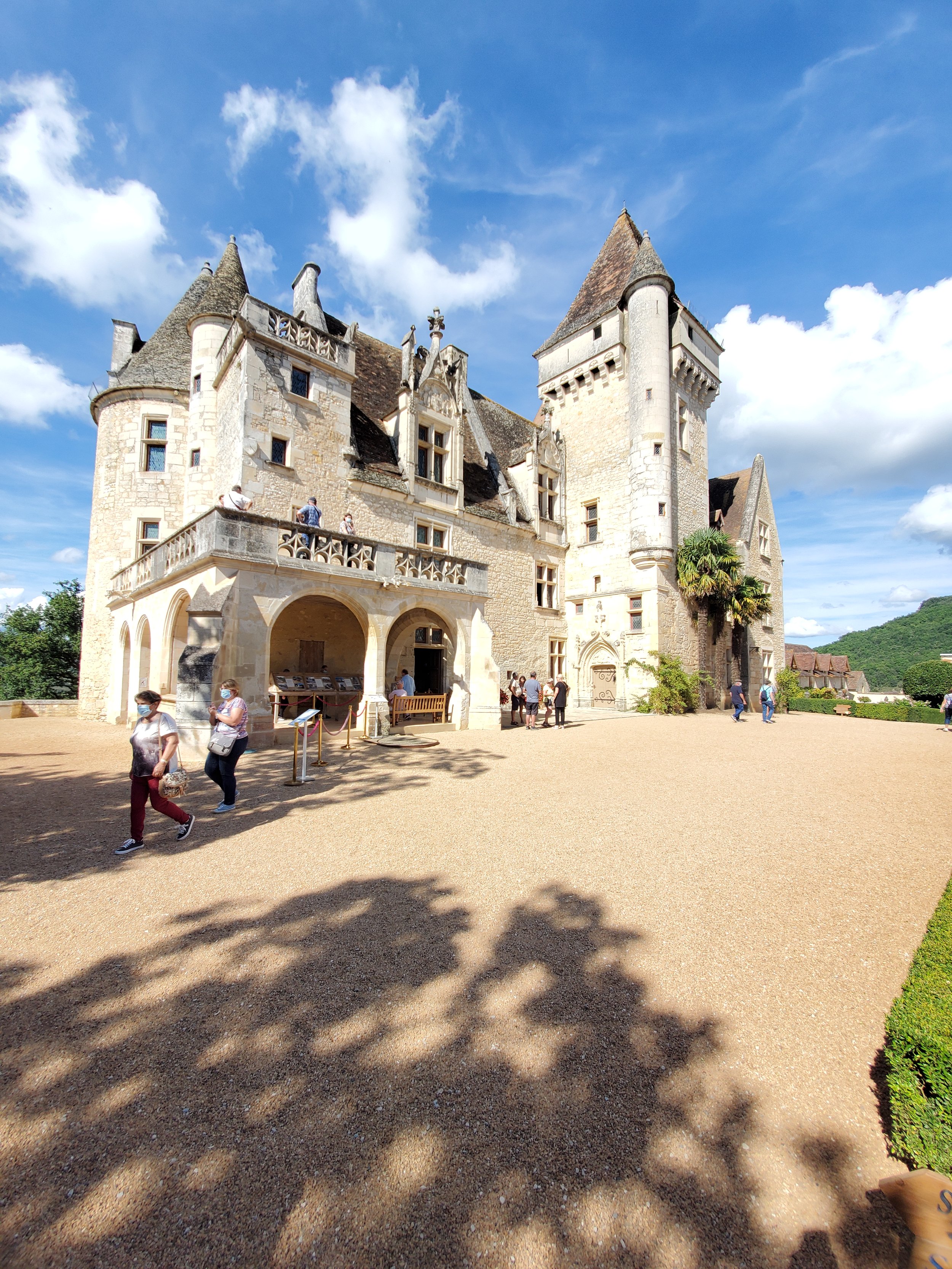
The Chateau des Milandes where she lived for 22 years. It is a majestic piece of Baker’s and France’s history, well-worth the visit. Caution, it is NOT in Paris.
Look Beyond the Famous Names
This is why the story of Americans in Jazz Age Paris should not end with Hemingway. If we only follow the famous writers, we see one version of expatriate Paris. Follow Baker instead, and another Paris emerges. A Paris of theaters and music. Of Montparnasse and the Left Bank. Of jazz and cabaret. Of American artists entering French cultural life. Of cultural exchange rather than cultural isolation.
And eventually, something far more profound than the Jazz Age itself emerges: belonging.
Baker came to Paris as a young American performer. France gave her a stage and Paris gave her a career. She gave France her talent, her courage, and ultimately her service.And somewhere along the way, the relationship changed.
She was no longer simply an American in Paris.
Walking Through Her Paris
Today, the Paris of Joséphine Baker is not contained within a single address. Rather her story crosses the city. The Théâtre des Champs-Élysées recalls the young performer who first stunned Paris. The world of the great Parisian music halls evokes the extraordinary career that followed.
Also the Left Bank and its surrounding neighborhoods recall the international cultural world of the Jazz Age, and as mentioned, the Panthéon offers a very different conclusion to the story. The question is no longer where an American artist performed. The Left Bank may be the most fascinating way to revisit the American Paris of the 1920s.
L'Autre Paris, our guiding concept at Inner Circle Paris suggests that the genuine narrative of the capital remains hidden directly beyond its stone walls, waiting for those who discover where to seek and find welcoming doors.
Josephine Baker's journey and her connection to Paris went far deeper than that of a mere spectator. Discerning visitors today, seeking refined private journeys instead of tourist crowded monuments, pursue a similar ideal: not just viewing the capital, but truly entering its heart.
Published by Inner Circle Paris
The People Who Make Paris Come Alive: Why a Guide-Conferencier Changes the Experience
There is a difference between seeing Paris and experiencing it.
You can stand before the Louvre, walk through Montmartre, admire the stained glass of Sainte-Chapelle, or wander the streets of Le Marais with a guidebook in hand. You can learn the names, dates, and architectural details. But Paris has always been a city of layers, of hidden histories, artistic movements, personalities, traditions, intrigues, and small details that reveal themselves only when someone knows where to look.
That is where a Guide-Conférencier makes all the difference.
More Than a Tour Guide
In France, the title Guide-Conférencier refers to a professionally qualified cultural guide whose role goes far beyond simply accompanying visitors from one landmark to another. Their training is rooted in subjects such as art history, history, architecture, cultural heritage, and the interpretation of France's extraordinary patrimony.
Their education gives them the foundation. Their experience gives them perspective. And their passion for Paris allows them to turn that knowledge into a story.
A great Guide-Conférencier does not overwhelm you with facts. They know which facts matter, and just as importantly, how to bring them to life.
Why was this building created here?
Who walked these streets centuries ago?
What happened behind that elegant façade?
Why did an artist choose this particular neighborhood?
What small architectural detail have thousands of visitors walked past without ever noticing?
Suddenly, Paris begins to reveal another face.
The Expertise Behind the Experience
At Inner Circle Paris, our Guide-Conférenciers are an integral part of what we offer. Their knowledge encompasses the history, art, architecture, culture, and heritage of Paris, complemented by individual areas of expertise and personal passions.
One guide may bring an especially deep understanding of the great museums and their collections. Another may have a particular fascination with architecture and the evolution of Paris. Another may be captivated by the literary, artistic, or social history hidden within the city's neighborhoods. Yet another may bring the spirit of Parisian cabaret to life in full French Can-Can costume.
This individuality matters because a private experience should never feel like a script being recited.
Our guides interpret Paris through their own knowledge and perspective while tailoring the experience to the interests and curiosity of each guest. Whether discovering masterpieces inside the Louvre, tracing the artistic history of Montmartre, exploring the Jewish heritage of Le Marais, or uncovering the elegant world surrounding Place Vendôme, the objective is the same: to make Paris feel personal.
Why Professional Qualification Matters
For a traveler choosing a private cultural experience, expertise matters.
Paris possesses an extraordinary concentration of museums, monuments, historic neighborhoods, architectural treasures, and cultural heritage. Understanding them properly requires more than knowing what appears in a travel guide.
Professional Guide-Conférenciers are trained to interpret that heritage responsibly and accurately, giving visitors context rather than simply information.
For Inner Circle Paris, that professional standard is paramount.
Our company operates as a registered French tour operator under Atout France, reflecting our commitment to operating within France's strictly regulated professional tourism framework. But credentials alone do not create a memorable experience.
People do.
And that is why our guides sit at the heart of Inner Circle Paris.
Paris, Through the Eyes of an Insider
We believe luxury travel is not simply about seeing more. It is about experiencing more deeply.
It is having someone beside you who can recognize the significance of an overlooked doorway, explain the story behind a seemingly ordinary square, connect a work of art to the person who created it, or lead you down a quieter street when everyone else is following the crowd.
It is the difference between being shown Paris and being introduced to Paris.
Our Guide-Conférenciers bring knowledge, discretion, warmth, curiosity, and a genuine love of the city to every experience. They are not simply the people leading our tours. They are part of the experience itself.
That is why, at Inner Circle Paris, we don't think of our guides as an addition to what we offer.
They have been selected to be an essential part of who we are.
Because the most memorable Paris is often not the Paris you find on a map.
It is the Paris revealed by someone who knows where to look.
Discover our selection of guides and their introductory videos under the heading About Us.
Published by Inner Circle Paris
What Le Marais Remembers
There is a strange thing about Le Marais. You can walk through it for an hour and feel as though you have crossed several different cities.
One street feels medieval. Another feels unmistakably aristocratic. Turn a corner and you are surrounded by the traces of a Jewish community whose story stretches across centuries. A few minutes later, the architecture changes again, the storefronts become more contemporary, and the neighborhood feels thoroughly, unmistakably modern. And yet you have barely moved.
That is the mistake we make when we talk about Le Marais as though it were simply one neighborhood.
It isn't. Le Marais is a collection of Parisian stories layered on top of one another, sometimes harmoniously, sometimes uneasily, and almost always within walking distance of each other.
That is what makes it worth slowing down for.
The Marais Before It Was the Marais
The name itself gives away something important. Marais means marsh. Before aristocrats built grand residences here, before Jewish families established businesses and synagogues, before today's galleries, cafés and boutiques, this part of Paris was literally wetland.
Religious communities helped drain and cultivate portions of the area, gradually transforming land that had been difficult to inhabit into productive ground. The physical landscape changed. Then the social landscape changed with it.
Paris expanded eastward. Royal power arrived. Wealth followed. Streets were laid out, residences constructed, and the district began becoming something very different from the marshland that gave it its name. The modern visitor sees the finished neighborhood.
But beneath it is a much older story: Paris learning how to make land into a city.
Then Paris's Most Powerful People Moved In
By the seventeenth century, the Marais had become one of the places where wealth and influence announced themselves. The great private residences known as hôtels particuliers transformed the neighborhood. But these buildings are easy to misunderstand. They were not simply beautiful old houses. They were statements. A grand entrance, a carriage courtyard, a formal garden, an elaborate staircase; all of these communicated something about the person who lived there.
Status.
Connections.
Money.
Power.
And perhaps a little ambition.
The remarkable thing is that many of these buildings survived while the people who built them disappeared from the neighborhood. That creates one of the great pleasures of walking through the Marais today. The architecture remains even when the social world that produced it has vanished. You can stand in front of a doorway and see stone. Someone who understands the building sees a social history.
And Then The Aristocrats Left
Neighborhoods change. The Marais eventually lost its position as the preferred address of Parisian high society as wealth and fashion moved elsewhere. And the grand residences did not disappear overnight. Instead, many acquired entirely different lives.
Buildings that had once belonged to aristocratic families became workshops, businesses, apartments and institutions. The Marais became less fashionable. In some places, it became crowded and neglected. And that change is essential to understanding the neighborhood. Because today's beautifully restored Marais can give the impression that it has always looked this way.
It hasn't. Its history includes periods of extraordinary wealth, decline, overcrowding, reinvention and restoration. The cracks are part of the story.
Then Another Paris Arrived
The Jewish history of the Marais is older than many visitors realize. Jewish communities were present in the area during the Middle Ages. After expulsions and centuries of upheaval, Jewish life re-established itself, and from the nineteenth century onward new arrivals (particularly Jews from Alsace and later from Europe) transformed parts of the neighborhood again.
Around the streets near Rue des Rosiers, a distinctly Jewish urban world developed. The Pletzl (Yiddish for “little place or little square”) became associated with this community. Synagogues appeared and shops opened and then bakeries and restaurants followed.
Languages changed. Families built lives and the neighborhood acquired another layer of identity.
Walk through the area today and you can still encounter traces of that history.But it is important to understand that the Jewish Marais is not simply a collection of restaurants and food shops. There is a story of migration, faith, family, survival and belonging. It is also a story marked by profound loss during the Holocaust. To walk these streets without knowing that history is to see only part of them.
Look at the Doorways
One of our favorite things about the Marais is that its history is often not presented to you. It has to be noticed. A doorway may lead into a courtyard that once belonged to a private residence. A plaque may identify someone whose life intersected with a major moment in French history. A building may reveal, through its proportions or architectural details, the social status of the people who once lived there. A street may preserve the memory of a community that is no longer there in the same form.
This is why walking through the Marais is different from simply checking off its landmarks. The neighborhood rewards attention. And sometimes the most interesting thing is not the building you came to see. It is the building beside it.
The Marais Has Another Identity Too
History does not stop. The Marais continued changing throughout the twentieth century.Artists arrived and new businesses appeared. The neighborhood became increasingly associated with galleries, fashion and design. And from the late twentieth century onward, the area also became closely associated with Paris's LGBTQ+ community and nightlife.
Today, these identities exist alongside the older ones. You have the aristocratic Marais, the Jewish Marais, the artistic Marais, the fashionable Marais, the residential Marais, the museum Marais and of course the everyday Marais. And none of them completely cancels the others. That is the point.
What Was Saved, and What Almost Wasn't
There is another chapter that deserves attention because the Marais we see today is not simply the result of good fortune. Much of the historic district fell into serious disrepair during the nineteenth and twentieth centuries. Some buildings were altered as others were subdivided.
Workshops occupied former aristocratic spaces. Historic fabric was threatened by modernization. Then came a major change in thinking. The preservation policies and the 1962 law protecting historic urban areas helped establish a new approach to the Marais. Rather than simply demolishing and rebuilding, Paris began treating historic neighborhoods as something worth preserving and restoring.
The Marais became the first Parisian area to receive this protected status in the 1960s. That decision fundamentally changed what you see when you walk through the neighborhood today. The beautiful Marais is, in part, a preserved Marais.
Which Marais Do You Want to See?
This is where the neighborhood becomes particularly interesting. If you come looking for grand architecture, the Marais will give you plenty. If you come looking for Jewish history, there are centuries of stories beneath the present-day streets. If you are interested in French aristocratic life, the hôtels particuliers provide an extraordinary window into another Paris.
If you are interested in literature, politics, art, fashion or history, the neighborhood has those stories too. And if you simply want to sit at a café and watch Paris go by, it is exceptionally good at that as well. The question isn't whether Le Marais is worth visiting. It is which Marais you want to discover. Are you willing to look for the others while you're there?
The Marais We Love
At Inner Circle Paris, we don't think of the Marais as a checklist. We don't want to rush from one famous building to the next and announce what you are looking at before moving on. We want to understand the connections. Why did this family live here? Why did this community settle here? Why did this building survive? Why did that street change? What disappeared and what remains?
The Marais doesn't need another checklist. It needs time, attention, and someone who knows how to read what remains. A doorway can change the story. A name on a façade can lead somewhere unexpected. A street that looks ordinary can suddenly reveal who lived there, who left, and why the neighborhood became what it is today.
That is how we experience the Marais at Inner Circle Paris. It’s not as a collection of sights to be checked off, but as a neighborhood to be understood.
Because once you know how to read the Marais, you never quite see it the same way again.
How to See Paris Differently: 10 Things Most Visitors Never Notice
Paris is remarkably good at hiding in plain sight.
You can walk past the same doorway every morning and never know what is behind it. You can stand in front of a celebrated monument and miss the story happening in the building next door. You can spend an entire afternoon in one of the world's greatest museums and never notice the light falling differently across the room at four o'clock.
The Paris most visitors come to see is extraordinary. But there is another Paris, too.
It is quieter and more intimate. Sometimes unexpected. At Inner Circle Paris, this is the Paris that interests us most. Not because the famous landmarks aren't worth seeing (they absolutely are) but because the city becomes something different when you learn to look beyond the obvious. Here are ten ways to begin.
1. Look up
One of the easiest ways to discover another Paris is simply to look above eye level. Parisian façades are filled with details that most people never notice: carved faces, wrought-iron balconies, unusual windows, dates engraved in stone, painted signs and architectural details that reveal the history of a building.
The street may be crowded. The architecture may seem familiar. Look up. You may discover that the building you've walked past ten times has been telling you its story all along.
2. Go through the door that doesn't look important

An ordinary wall, an ordinary door, an ordinary knob… or is it?
Some of Paris's most beautiful spaces are hidden behind completely ordinary entrances.
A narrow passageway can lead to a courtyard. A modest doorway can open onto an hôtel particulier. A seemingly unremarkable entrance can reveal a garden, workshop, gallery or architectural detail that never appears on a typical sightseeing itinerary.
Paris rewards curiosity. If a doorway makes you wonder “What's behind that?”, that's usually a good reason to take a closer look. At Inner Circle Paris many seemingly plain and bland doors have yielded countless treasure troves.
3. Walk one street away from the obvious
The most photographed street is rarely the only interesting one. In neighborhoods such as Le Marais, Montmartre and the Latin Quarter, the atmosphere can change dramatically within a few minutes of walking.
Step away from the main thoroughfare. Listen to the sounds. Notice the shopfronts. Look at the people who actually live and work there. Pay attention to the small businesses that have survived while the city around them changed. This is often where a neighborhood begins to feel less like a destination and more like a place.
4. Learn to recognize an hôtel particulier
Paris has an extraordinary architectural secret hiding in plain sight, hôtels particuliers. Despite the name, these were not hotels in the modern sense. They were grand private residences, often built for members of the aristocracy and wealthy Parisian families. Finding the one in the 18th arrondissement in Montmartre and ringing that doorbell is exquisite.
Many are easy to miss from the street. Behind imposing façades are courtyards, gardens, staircases and architectural details that tell us how Paris's elite once lived. Le Marais is particularly rich in them. Once you know what you're looking at, you'll begin seeing them everywhere.
5. Follow the history of the people who lived there
A neighborhood becomes much more interesting when you stop seeing it as a collection of buildings and start seeing it as a collection of lives.
Who lived here?
Who worked here?
Who worshipped here?
Who wrote here?
Who rebelled here?
Who left, and who stayed?
This is particularly revealing in neighborhoods such as the Marais, where centuries of aristocratic, commercial and Jewish history exist within a remarkably concentrated area. A street name can become a clue. A bakery can become part of a much larger story. A courtyard can suddenly have a history. That is when Paris begins to feel three-dimensional.
6. Enter a covered passage
Paris's covered passages are among the city's most atmospheric survivors from another era. Built largely in the nineteenth century, these elegant arcades once offered Parisians protection from mud and rain while creating a new kind of shopping and social environment.
Today, some are beautifully restored. Others retain a slightly faded elegance that is part of their charm. Look for the details: mosaic floors, glass roofs, old shopfronts, bookshops, galleries and signs that seem to belong to another century. And then imagine Paris before department stores transformed the way the city shopped.
7. Visit a famous place at an unexpected hour
Sometimes the place doesn't need to change. You simply need to arrive at a different time. A museum in the morning can feel completely different later in the day. A historic square can transform as the light changes. A neighborhood that feels busy at midday may become almost contemplative in the early evening.
This is one of the great advantages of a private experience. You don't always have to follow the schedule everyone else follows. Sometimes the secret isn't where you go. It's when you go and who accompanies you.
8. Let the neighborhood, not the checklist, set the pace
There is a temptation when visiting Paris to measure a day by landmarks. Eiffel Tower. Louvre. Notre-Dame. Arc de Triomphe. And yes, see them. But don't let the checklist become the entire experience.
Choose a neighborhood and allow yourself to spend time there. Notice how its character changes from one street to the next. Stop for coffee. Look inside a shop. Sit in a square. Follow an architectural detail. You may see fewer monuments. You may remember more.
9. Ask what is still here
Paris is a city that has reinvented itself repeatedly. Revolutions, renovations, wars, changing fashions and modern development have all left their marks. So when you encounter something old, don't simply ask:
“How old is it?” Ask: “How did this survive?”
That question often leads somewhere much more interesting. A family business that has survived for generations. A historic garden. A centuries-old tradition. A building that escaped demolition. These are the threads that connect today's Paris to the city that came before it.
10. Find someone who knows where to look
This may be the most important one. Paris doesn't require a guide to be beautiful. But a knowledgeable expert guide can change what you notice. They can tell you why a particular building matters. Point out the courtyard you would otherwise walk past. Explain the symbol carved into a façade. Connect a street to a person, an event or a story you would never have known existed. The difference isn't simply information. It's context. And context changes the way you see a place.
The Other Paris Is Still There
You don't have to avoid the Eiffel Tower to discover authentic Paris. You don't have to reject the Louvre to find something unexpected. You don't have to follow an obscure itinerary simply for the sake of being different.
The point isn't to avoid the Paris everyone knows. It's to look at it differently. Because the extraordinary and the ordinary exist side by side here. The famous monument and the forgotten doorway. The grand boulevard and the tiny courtyard. The celebrated museum and the workshop around the corner. The Paris everyone photographs and the Paris almost no one notices.
At Inner Circle Paris, these are the moments we look for, not simply the places you should see. The places that make you stop and say:
“How did I never notice this before?”
That is the Other Paris, L’Autre Paris. And she is waiting, as she always has been, just around the corner.
The Other Face of Paris. L’ Autre Paris

How did we get this view?
The Other Face Of Paris. L’ Autre Paris
There is the Paris everyone sees, and then there is the other Paris, the Paris that everyone misses — standing, most of the time, in exactly the same place.
It is the courtyard behind the café where you just had your coffee. The atelier three doors down from the monument, still run by the great-granddaughter of the man who opened it. The hour just before a museum closes, when the light changes and the crowds thin and a room full of paintings suddenly belongs to no one but you.
This is not a secret. It is simply a matter of who is standing beside you, and whether they know where to look.
The Trouble with Seeing a City in a Crowd
Most tours are built for volume. A guide, a flag held aloft, forty strangers moving at the pace of the slowest among them, past facts recited the same way to every group that came before. It is efficient and quick. It is also too generic a way to meet a place as layered and particular as Paris.
Curation is not a luxury add-on to travel — it is the entire difference between visiting a city and getting to know one, even briefly. A curated experience asks a different question than a standard tour does. Instead of what should everyone see, it asks: what should you see — given your curiosities, your pace, the version of Paris you're actually hoping to find.
That question can only be answered in private. Not because privacy is indulgent, but because attention is. A guide speaking to four people, or six, notices what you linger on. They adjust. They tailor. They take the turn down the smaller street because you mentioned, in passing, that you love calligraphy, or Baroque organs, or the particular blue of a certain painter's shadows. None of that is possible in a group of forty.
What "Inner Circle Paris" Means to Us
We named this company for a simple belief: that the best way to know Paris is the way Parisians know it themselves — through relationships. Through the boulanger who saves the last pain de campagne, the gallery owner who opens early for people she trusts, the quiet arrangement between neighbors that turns a locked garden into a shared one.
That ever-growing love for Paris — her quartiers, her markets, her history, and her inexhaustible ability to surprise — is the foundation upon which Inner Circle Paris is built. We are not a big tour company. We are two people who fell deeply and irreversibly in love with one of the world's great cities, and wanted to share that love in the most authentic way we could imagine. Every tour we offer reflects something we have personally experienced and personally felt, because the best travel experiences are never really about the places themselves. They are about the stories, the connections, and the moments of genuine discovery that change the way you see the world.
Inner Circle Paris is not exclusive because it wants to keep people out. It's exclusive because trust and care don't scale, and we'd rather do a few things exceptionally than many things adequately. Every itinerary we build is private, and every private itinerary is different — shaped around who you are, not around a script.
This means:
No fixed itineraries. Your guide-conferencier designs the day around your interests — architecture, food, art history, literary Paris, quiet Paris, whatever draws you.
No one else. Every tour is private: your party, your guide, your pace.
No recitations. Our guide-conferenciers who all hold a professional license are Paris specialists, not script-readers.
No wasted time. We plan around the hours when places breathe.
An Invitation, Not a Brochure
We didn't start this company to sell tickets to landmarks. Landmarks will still be standing long after any of us are gone; they don't need us. What Paris does need — what any city worth knowing needs — is someone willing to walk it slowly, again and again, until the unremarkable corners start to reveal themselves too.
That is the work. Finding the version of Paris that fits the person in front of us, and then simply opening the door.
Consider this our welcome. The city is, as it always has been, extraordinary. We'd like to show you the parts of it that are still quiet enough to hear.
— Inner Circle Paris