
There are few places in Paris where so little seems to happen, and yet so much can be observed, as at a small café table.
Two chairs. A round tabletop. Perhaps a coffee, a croissant, a newspaper, a glass of wine or a half-finished conversation. Beyond it, the city continues its familiar choreography: bicycles pass, footsteps echo against the pavements, a waiter balances a tray, and somewhere across the street, a stranger pauses to watch the world go by.
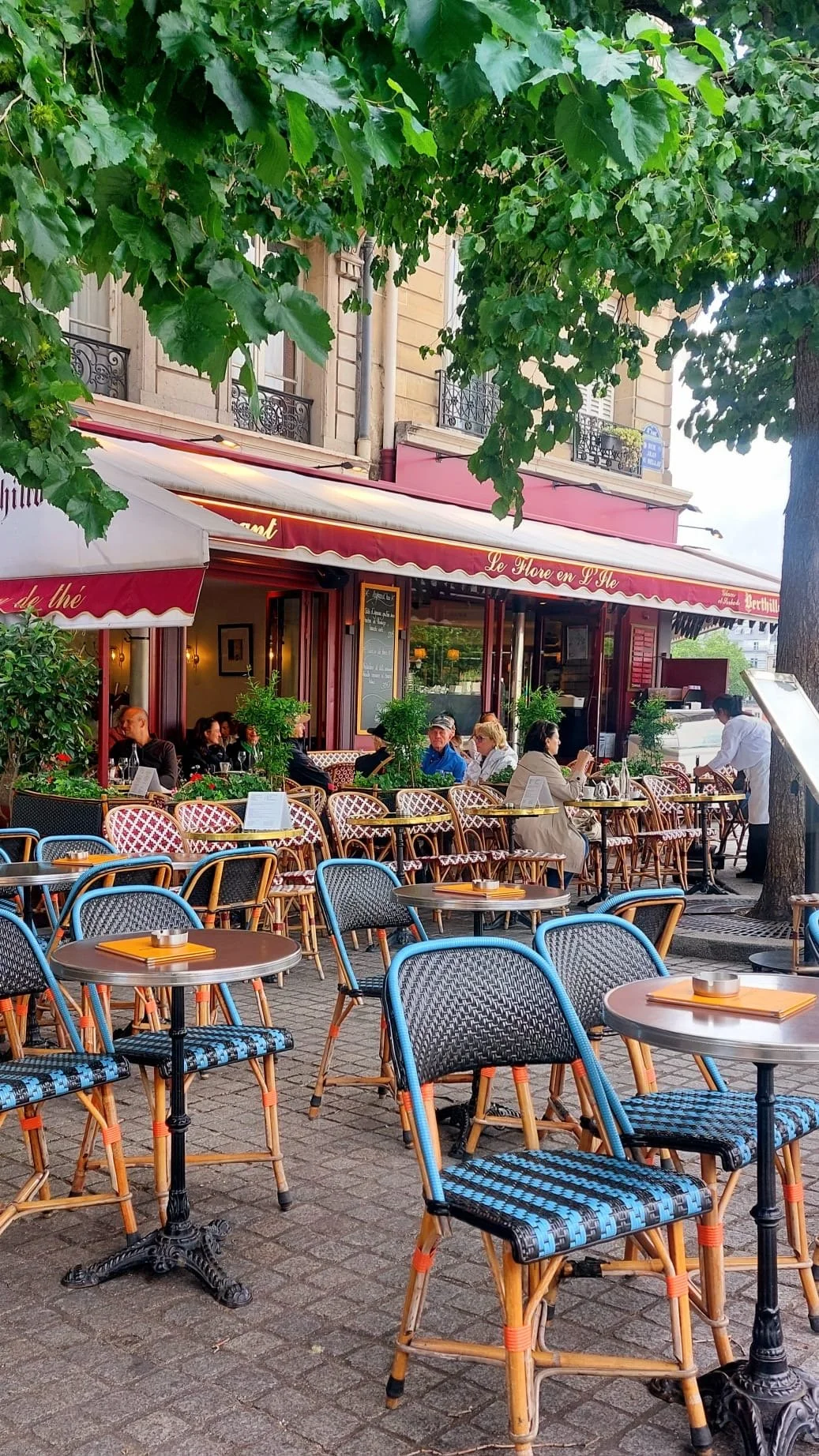
The Parisian café table is not particularly grand. It does not demand attention. Yet, over the centuries, it has become one of the most recognizable symbols of the French capital. To understand its place in Paris, one must look beyond its wood, marble or cast-iron base. Its real history is found in the people who have gathered around it.
Where Coffee Found Its Place in Paris
Coffee arrived in Paris during the seventeenth century, bringing with it a new kind of social experience. By the late 1600s, cafés were beginning to establish themselves as places where people could meet outside the formal arrangements of private homes and aristocratic salons.
One establishment would become particularly important.
In 1686, Francesco Procopio dei Coltelli, a Sicilian entrepreneur, opened the Café Procope on what is now Rue de l'Ancienne-Comédie, in the Saint-Germain-des-Prés area. Its refined interior, mirrors, chandeliers and small marble tables helped establish a new setting for Parisian social life.
The café offered something different from the traditional tavern. It was a place to sit, converse, exchange opinions and spend time in the company of others without necessarily belonging to the same social circle. We explored this remarkable neighborhood in our previous article, Saint-Germain-des-Prés: Where Paris Thought Out Loud.".
Soon, cafés became associated with the intellectual life of the Enlightenment. Voltaire, Rousseau and Diderot were among the celebrated thinkers connected with this emerging culture of discussion.
The little table had found an unexpectedly important purpose: it provided a place where ideas could be exchanged.
A Table Without a Head
There is something quietly democratic about the traditional café table.
Unlike the grand dining tables of aristocratic residences, it has no obvious head, no assigned place of importance and no elaborate ceremony. A person might sit alone, meet a friend, conduct business or simply observe the passing world.
During the eighteenth century, Parisian cafés became increasingly important spaces for public conversation. Their appeal extended beyond the intellectual elite, although access and social conventions were not the same for everyone.
In the years leading up to the French Revolution, cafés became places where political opinions circulated and public sentiment could gather momentum.
At the Café de Foy, near the Palais-Royal, Camille Desmoulins famously addressed a crowd in July 1789, helping ignite revolutionary fervour.
It is a remarkable thought that a city accustomed to discussing ideas around small café tables would eventually see some of those ideas carried into the streets.
The café table was never simply somewhere to put a cup. It was a place from which one could participate in the life of a city.
When Paris Took Its Cafés Outdoors
As Paris transformed during the nineteenth century, so did the relationship between its cafés and its streets.
The expansion and modernization of the boulevards, particularly during the Second Empire under Napoleon III and the urban works associated with Baron Haussmann, changed the way Parisians experienced public space.
Wider avenues, improved pavements and increasingly fashionable commercial districts helped create the conditions for café terraces to become an enduring feature of the Parisian landscape.
The table moved closer to the street.
What had once been primarily an interior experience became something altogether different. Patrons could now enjoy their coffee while watching the city unfold in front of them.
This was the beginning of one of Paris's most enduring rituals: sitting outside, facing the street, with very little urgency to be anywhere else. The arrangement was simple, but its appeal was extraordinary and still powerfully enjoyable today.
A café terrace offered the comfort of a familiar place and the entertainment of an ever-changing public spectacle. One could read, flirt, work, argue or do absolutely nothing.
In Paris, doing nothing has occasionally been elevated to an art form.
The Café Table and the Artists of Paris
By the late nineteenth and early twentieth centuries, cafés had become deeply woven into the artistic and literary life of Paris.
Writers, painters, philosophers and musicians found in them something that a private studio or drawing room could not always provide: the energy of the city itself.
The café table became an informal extension of the workplace.
A notebook could replace a dinner plate. A conversation could become the beginning of a novel. A passing face might inspire a painting or a character.
In Montparnasse, cafés such as La Rotonde, Le Dôme and La Closerie des Lilas became associated with artists and writers who helped shape the cultural reputation of Paris. Later, Saint-Germain-des-Prés developed its own intellectual identity. At cafés such as Les Deux Magots and Café de Flore, Jean-Paul Sartre and Simone de Beauvoir became closely associated with the postwar intellectual atmosphere of the Left Bank.
For these writers and thinkers, cafés offered a place to work, debate and observe. The table was not necessarily an escape from the world. It was a way of remaining in the middle of it.
And perhaps that is the secret of the Parisian café table: it allows one to be both present and apart.
The Small Details That Make a Parisian Café
The traditional Parisian café table has a visual language all its own.
There are the small round tabletops, often marble or wood, the slender metal bases and the familiar wicker or rattan-style chairs. Some terraces are arranged in precise rows, with every chair facing the pavement rather than its companion.
To visitors, the arrangement can seem unusual. Why sit shoulder to shoulder with a stranger rather than face the person across the table?
But there is a certain logic to it.
The café terrace is not simply a place for private conversation. It is a place for watching Paris. The street becomes the performance, and the people seated around the tables become its audience.
A waiter moves between the chairs with practiced familiarity. Cups arrive, glasses catch the afternoon light, and conversations continue at their own pace.
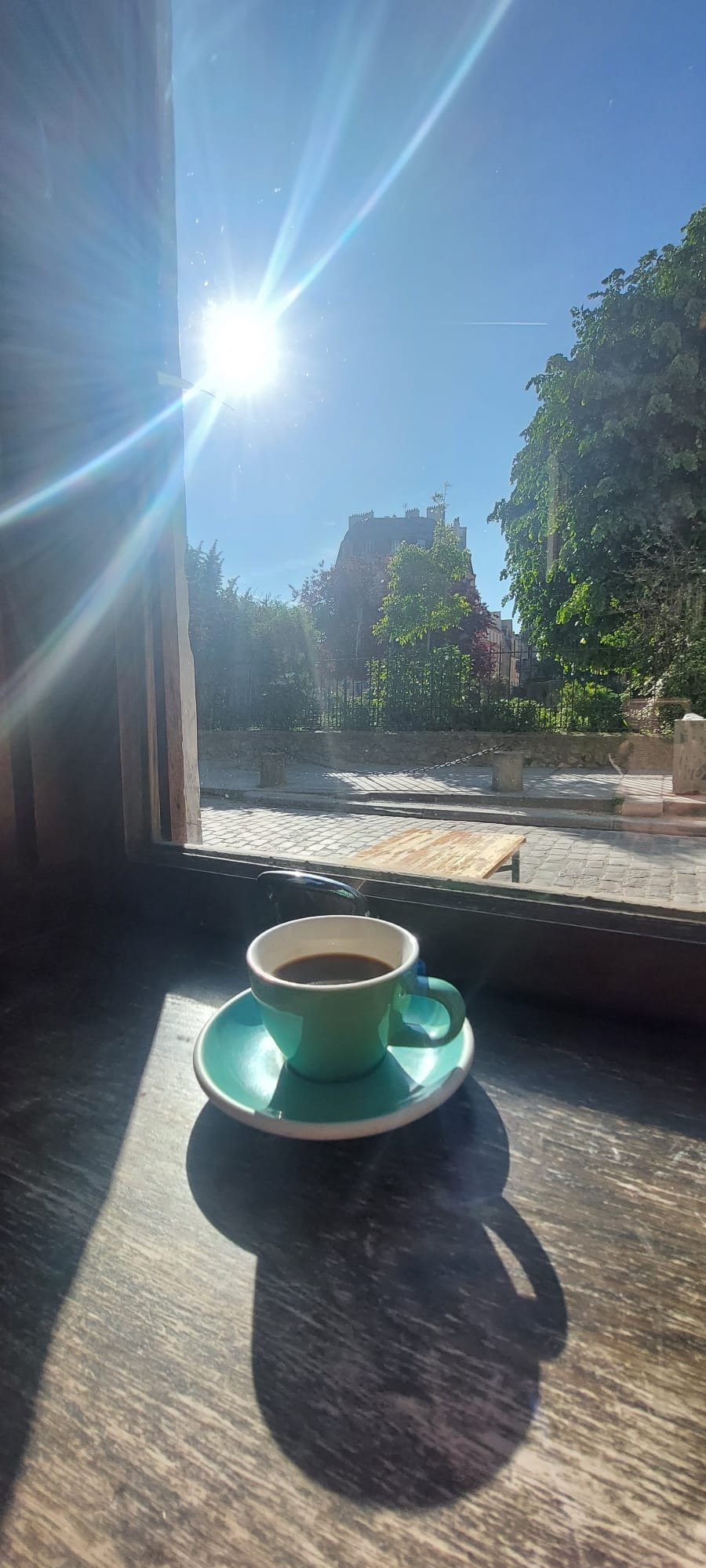
Even the smallest details have their place.
The espresso served in a porcelain cup. The newspaper folded beside a glass. The chair angled just enough to follow the movement of the pavement. Nothing needs to be particularly elaborate. Although, for a rather different interpretation of Parisian café elegance, consider the Starbucks Capucines near Opéra Garnier. Its magnificent nineteenth-century ceiling murals have been carefully restored, revealing an unexpectedly lavish interior. In either setting, the atmosphere does the work.
A Ritual That Has Outlived Generations
Paris has changed considerably since its first cafés opened their doors.
Its streets have been redesigned, its population has evolved, and the rhythms of daily life have accelerated. Yet the café table remains remarkably constant.
It accommodates the hurried morning espresso and the leisurely afternoon pause. It welcomes the solitary reader as readily as the group of friends who have lost track of time.
For some, it is a place to begin the day. For others, it is where the day finally slows down.
And for visitors, it offers something that no monument or museum can quite replicate: an opportunity to experience Paris as the Parisians themselves do, even if only for an hour.
Perhaps this is why the café table remains so evocative. It does not preserve history behind glass. It allows history to continue happening around it.
The Art of Sitting Still in Paris
There are cities best understood by moving through them. Paris is certainly one of those cities, with its monuments, hidden passages, elegant façades and winding neighbourhood streets.
But there is another way to discover it.
Find a small table on a terrace. Order a café crème or a café allongé. Resist the temptation to check the time. Watch the waiter, the bicycles, the conversations and the changing light on the buildings opposite.
You may begin to notice things that would otherwise pass unseen.
A couple sharing a quiet moment. An elderly gentleman greeting the waiter by name. A shopkeeper taking a brief pause. A young woman writing in a notebook, seemingly unaware of the world around her.
The café table has witnessed revolutions, artistic movements, literary debates and countless ordinary afternoons. Its history is not measured by the number of people who have sat around it, but by the lives that have briefly intersected there.
At Inner Circle Paris, we believe in discovering l’autre Paris, discovering a city by understanding more than its celebrated landmarks. It means recognizing the small rituals, familiar corners and seemingly ordinary details that give a place its soul.
And sometimes, the best way to discover Paris is not to see more of it.
It is simply to sit down, order a coffee and let Paris come to you.
Inner Circle Paris, Discover Paris Beyond The Ordinary