
The Paris Between the Banks
There is a particular kind of Paris that reveals itself only when you cross the Seine.
You may notice it halfway across a bridge. The architecture shifts almost imperceptibly. The rhythm of the street changes. A familiar Paris gives way to another, not better, not more beautiful, simply different.
And for a moment, you understand something about this city that a map can never quite explain. Paris has two banks. But it has never been only two cities.
The Seine runs through its heart, separating the Rive Gauche from the Rive Droite, yet the history of Paris has always been written across that divide. People crossed it. Ideas crossed it. Money crossed it. Art crossed it. Fashion crossed it.
And Paris became Paris in the crossing.
A River, Not a Line
We tend to look at the Seine as a boundary.
On one side, the Left Bank and on the other, the Right.
It is an easy way to orient ourselves. Stand facing the direction of the river's flow and the geography becomes wonderfully simple. But Paris has never been simple.
The Seine was once a working river at the center of daily life, a place of commerce, transportation, labor and exchange. Long before it became the backdrop for romantic walks and evening photographs, it was part of the machinery of the city itself.
The river did not merely divide Paris. It helped it function, and the bridges did something equally important. They made the division temporary. Every bridge offered a passage from one world to another. That may be why crossing the Seine still feels like more than getting from one arrondissement to another.
It feels like entering another chapter.
The Paris of Ideas
The Left Bank acquired its particular mythology slowly.
The presence of the University of Paris and the intellectual life surrounding the Latin Quarter helped establish the southern side of the river as a place of learning and debate.
Centuries later, that identity would acquire a more romantic vocabulary; Booksellers. Cafés. Artists. Writers. Philosophers. The long conversations of Saint-Germain-des-Prés. The studios and cafés of Montparnasse.
The Left Bank became a kind of shorthand for a Paris that preferred questions to answers. But mythology has a way of becoming more powerful than reality. The Left Bank was never simply a city of artists and intellectuals. Nor did everyone who crossed its streets spend the afternoon discussing philosophy over coffee.
Paris was always messier than its legends. That is precisely what makes the legends worth knowing.
The Paris of Ambition
Across the river, another Paris was taking shape.
The Right Bank became associated with commerce, royal power, grand avenues, markets, theaters, finance and the public spectacle of the capital. It was a Paris that looked outward. A Paris of movement, ambition, and display.
Later, it would become the Paris of great department stores, couture houses, elegant hotels and some of the city's most recognizable addresses. The Champs Elysées in July is always replete with enormous crowds for the final stage of the Tour de France.
The grand gesture belongs naturally here. The boulevard. The palace. The façade. The window display. The extraordinary made visible. And yet even this description is incomplete.
Because the Right Bank contains quiet courtyards, medieval streets, intimate neighborhoods and communities whose histories have little to do with grandeur. Le Marais alone makes the old stereotypes difficult to sustain.
Paris has always resisted the categories we create for it.
Then Something Happens Between Them
Perhaps this is where the real story begins. Not on the Left Bank or the Right Bank. But somewhere between the two.
Stand on the Pont des Arts and look in either direction: Behind you, one Paris. Ahead is another. The distance is almost nothing, but the difference can feel enormous.
And then you realize that the two views belong to the same city.
This is one of Paris's quietest tricks. It creates contrasts without requiring separation. The intellectual and the extravagant. The intimate and the monumental. The ancient and the modern. The private and the theatrical.
They coexist within walking distance of one another… sometimes within a few minutes.
The Islands Refuse to Choose
Then there are the islands.
The Île de la Cité sits in the middle of the Seine, carrying some of the deepest layers of Parisian history with it. Notre-Dame, Sainte-Chapelle, the medieval heart of the city.
Here, the distinction between Left and Right becomes almost poetic. The island belongs entirely to neither. It sits between them. And perhaps that is exactly where it should be. Because the oldest Paris was never really about choosing a side. It was about connection.
The city grew around the river, across it and through it. Its history is full of crossings.
The Myth of Choosing
Today, visitors are often invited to choose. Which bank is better? Where should you stay? Which side feels more Parisian? Which one has the better cafés, the better shopping, the better atmosphere?
It is an entertaining question and it is also the wrong one because the magic of Paris is not that one side wins. The magic is that they are different enough to create tension, and close enough to allow you to experience that tension in a single afternoon.
You can begin among the quiet streets of the Latin Quarter, cross the river, pass into the grandeur surrounding the Louvre, continue toward the covered passages, turn another corner and find yourself somewhere entirely unexpected.
Nothing has been lost.
Paris has simply changed its voice.
The Bridges Are Part of the Story
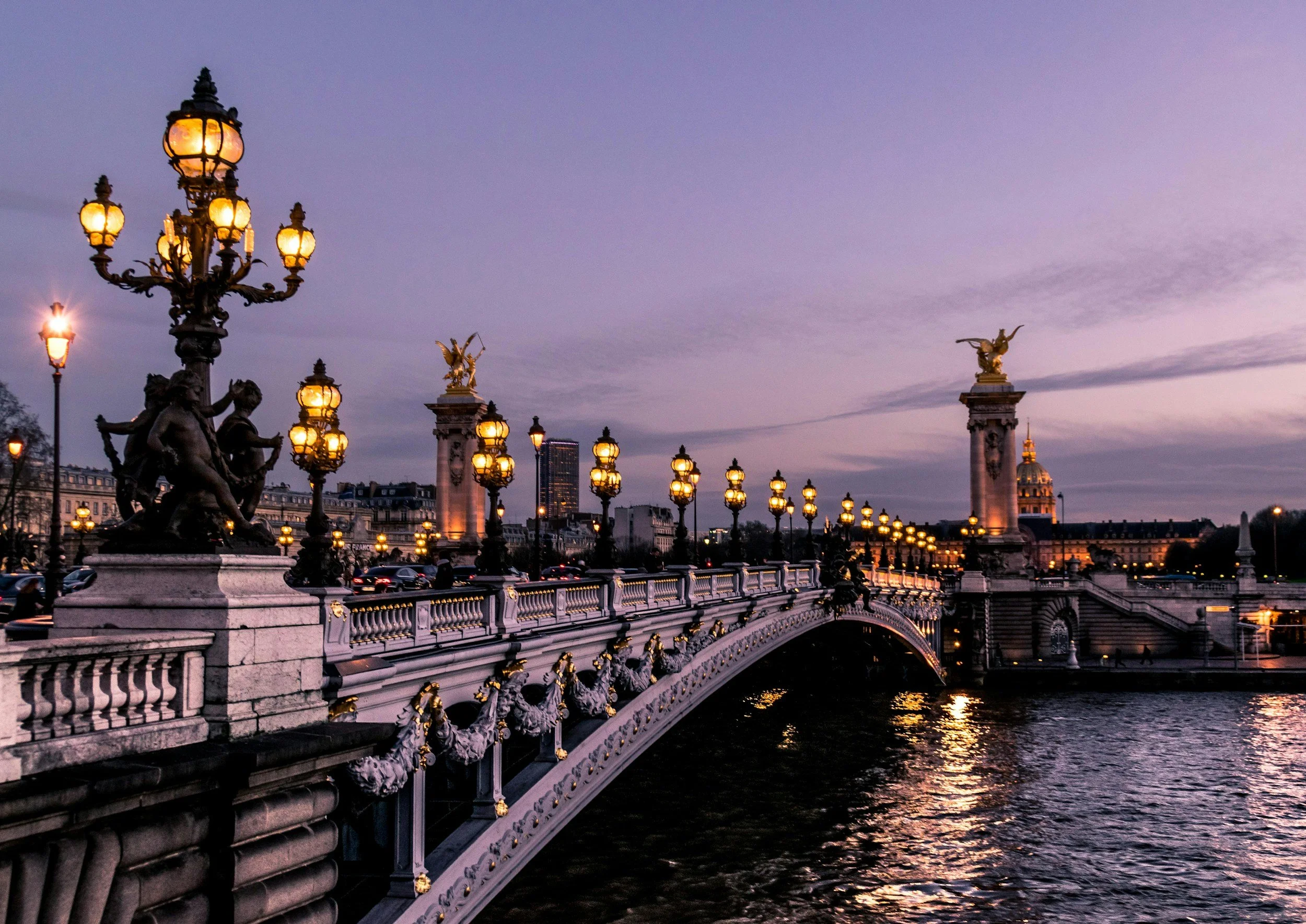
The Ruler of Bridges: Pont Alexandre III
Perhaps we give bridges too little attention as we use them without really seeing them. Yet in Paris, a bridge can be one of the most revealing places in the city. And it is where the perspective opens. Where façades line up and where the river suddenly becomes visible as something more than water. It’s where you can look backward and forward at the same time. And perhaps that is why some of the most memorable moments in Paris happen while walking somewhere rather than arriving somewhere.
You are between destinations. Between neighborhoods and histories. Between one version of Paris and another.
You are, quite literally, in between.
The Paris That Doesn't Announce Itself
The Paris worth discovering is rarely the Paris that needs to announce itself. It may be an architectural detail above a doorway. A courtyard hidden behind an ordinary façade.
A tiny street a few minutes from a celebrated monument, a story that connects a neighborhood to a person who lived there centuries ago, or one bridge crossed thousands of times, suddenly seen differently.
This is the Paris that exists beneath the familiar Paris.
And perhaps that is why the distinction between Left Bank and Right Bank remains so useful, not because it tells us exactly what each side is, but because it gives us a reason to cross from one to the other.
Perhaps There Is No Better Side
The question was never really about which bank is better. It was about what happens when you experience both. Paris does not ask you to choose between thought and beauty, history and modernity, intimacy and grandeur. It offers all of them.
Sometimes within the same block. Sometimes within the same view. Sometimes on opposite sides of the same river. And perhaps that is the great pleasure of Paris: You are never quite finished crossing it.
Discover Paris Beyond the Ordinary
At Inner Circle Paris, we are drawn to this version of the city. Not simply the Paris of monuments, but the Paris of connections.
The story behind the façade, the neighborhood behind the landmark, the detail most people walk past, or the relationship between places that, at first glance, seem to have nothing to do with one another.
Our private experiences are designed for travelers who want more than a list of places to see.They are for those who want to understand why Paris feels the way it does. Because Paris is not a collection of sights. It is a conversation and sometimes, the most interesting part of the conversation is the moment you cross the river.
Paris revealed by someone who knows where to look.
At Inner Circle Paris, our purpose, our joie de vivre, is to discover l'autre Paris, the other Paris. The Paris beyond the ordinary.
Inner Circle Paris