
Paris in the Rain: L’ Autre Paris or Is It?
There is a version of Paris that exists beneath blue skies.
It is the Paris of postcards and terraces, of long summer evenings along the Seine, of gardens in bloom and monuments illuminated by late afternoon light and it is beautiful.
But it is not the only Paris. There is another city that appears when the sky turns gray.
The limestone darkens. Windows glow against the weather. The pavement begins to hold the reflections of buildings, streetlights and passing umbrellas. People move a little more slowly. A doorway becomes interesting simply because it is dry.
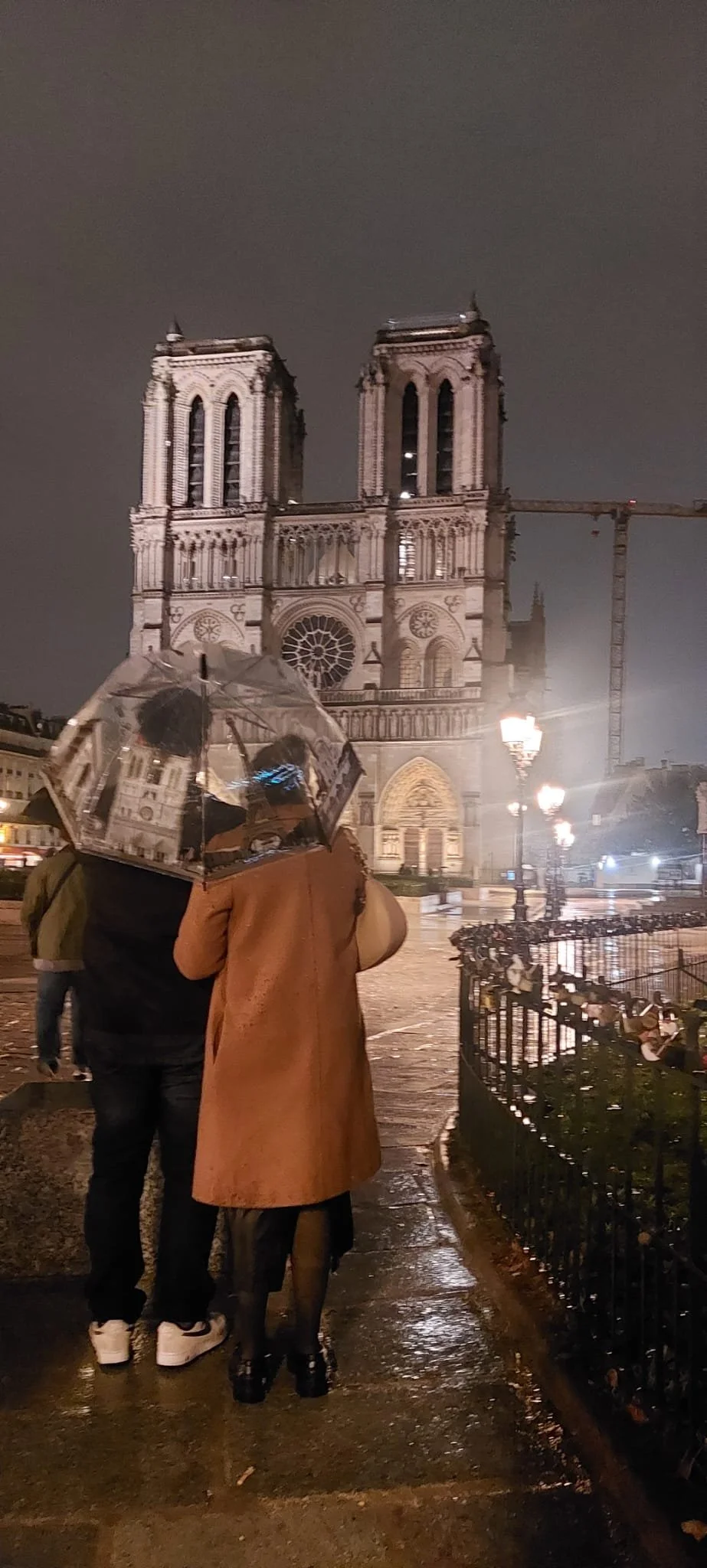
The iconic monuments in the umbrella are sublime
Nothing about the city has really changed. And yet, somehow, everything has. Perhaps that is the secret of Paris in the rain.
The rain doesn't give you a different Paris. It gives you a different way of seeing the one that was already there.
Paris Without the Postcard
Travel encourages us to look for the perfect version of a place. We want the photograph without the crowd. The monument beneath perfect light. The café table on the terrace. The view exactly as we imagined it. But cities are not photographs. They are lived places.
Paris was never meant to be experienced entirely from a carefully composed frame. Its character is found in the transitions between things: the street between two landmarks, the doorway beside the monument, the conversation at the next table, the building you almost didn't notice.
Rain interrupts the postcard. And that interruption can be liberating. Suddenly, you are less concerned with whether the day looks perfect and more interested in what the city is actually doing.
A flower seller pulls a canvas over her stall. A waiter gathers chairs beneath an awning. Someone pauses beneath an old stone archway to answer a telephone. A child jumps over a puddle swinging on dad’s arm, steadying his leather school bag on his back.
A couple shares an umbrella without saying a word, glancing at each other furtively.
None of these moments appears on a conventional itinerary. Yet together, they are Paris.
Rain Changes Your Pace
There is a peculiar pressure attached to visiting a great city. You feel that you should be seeing something. Then something else. And something else after that. The museum. The monument. The neighborhood. The famous street. The photograph. By the end of the day, you may have seen an extraordinary number of things without having really been anywhere.
Rain has a way of challenging that habit. It asks you to slow down.
Not necessarily because you have nowhere to go, but because suddenly the journey itself becomes more noticeable. You begin looking beneath the awnings. You notice the architecture above the shopfronts as you sip on the chocolat chaud (hot chocolate) while clasping the cup with both hands.
You take the longer route because it is more interesting. You stop and pause for five minutes rather than passing something by. Five minutes can be enough. Enough to notice the carved initials above a doorway. Enough to wonder who lived behind those windows. Enough to realize that the building you have walked past twice today is older than the street surrounding it. Enough to begin asking questions.
That is when Paris starts becoming more than a destination.
The Details Come Forward
Bright sunlight can be spectacular. But it can also be overwhelming. Paris has so much visual information that we sometimes see everything at once and, therefore, we see very little.
Rain simplifies the picture. The wet pavement draws the eye downward. The gray sky softens the distance. The trees, the fountain, the courtyard become more pronounced.
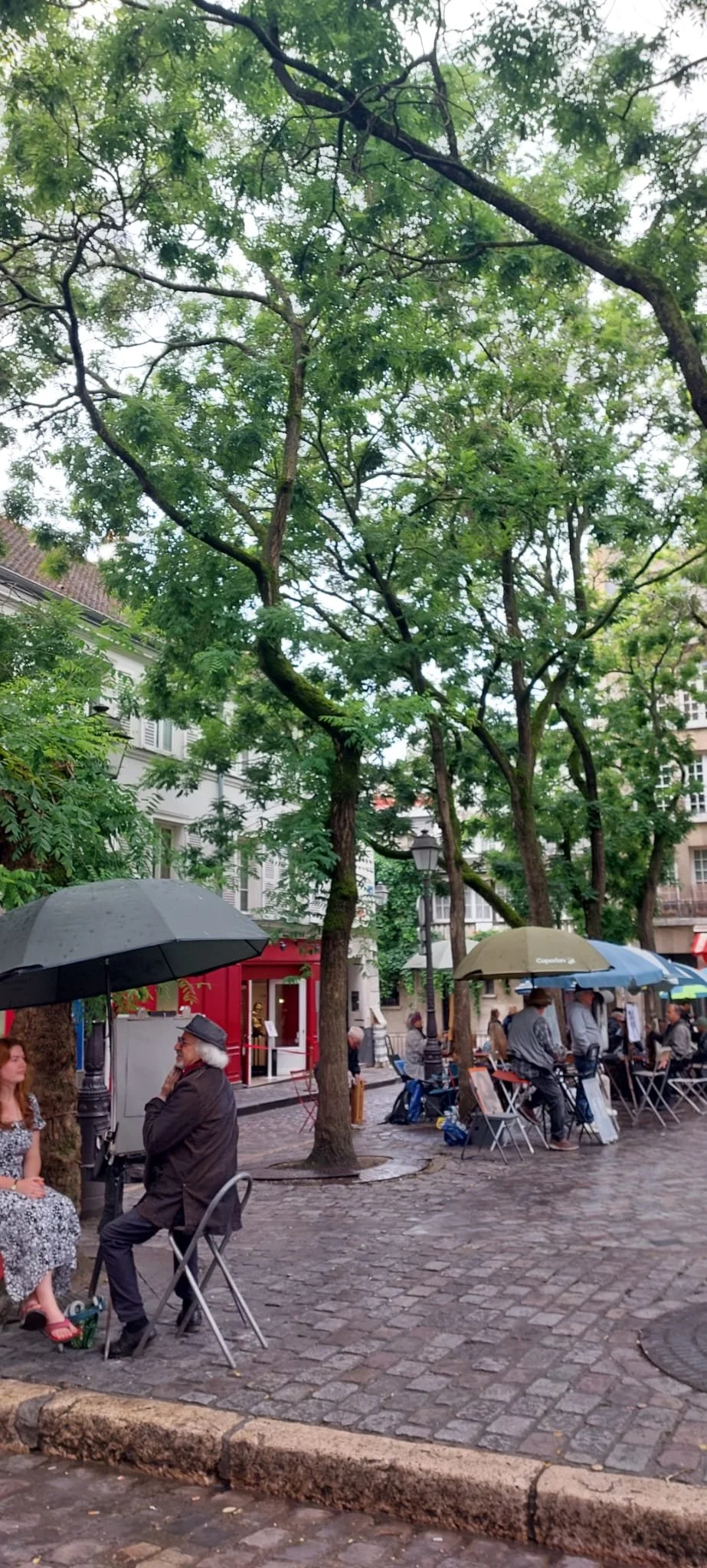
Rain drops on the umbrella never deter the artist… or the selective traveler
The calligraphy of the old sign above a shop catches your attention. The details that normally compete with one another begin to separate. You start looking differently.
And Paris rewards people who look differently.
The city is filled with evidence of the people who came before us: names of building architects of old carved into stone that reveal wealth or ambition, dates above doors, traces of businesses that have disappeared and neighborhoods that have changed beyond recognition.
Much of this is easy to miss when you are moving quickly. Rain gives you an excuse to stop.
The Luxury of Not Being in a Hurry
There is another reason rainy Paris can be particularly appealing to the discerning traveler. It makes something increasingly rare possible: unstructured time.
Not wasted time. Not time between attractions, but time that belongs to you.
A long lunch that becomes longer than expected. A conversation that isn't interrupted by the next scheduled departure. A gallery that deserves another twenty minutes. A street you follow simply because it looks intriguing.
There is a particular kind of luxury in not having to maximize every hour and Paris rewards it. The city has never been particularly good at being rushed. Perhaps we shouldn't ask it to be.
The City Reveals Its Habits
One of the pleasures of rain is watching what happens when Parisians encounter it. The rhythm of the city shifts, but life continues. The bakery remains open. The market still lives. The woman with the weathered face still drags her produce filled grocery cart while covering her hair with her scarf.
The Métro carries people across the city. The streets empty and then fill again.
When you watch how people live in Paris rather than simply what they have come to see, you begin to understand something that no photograph can explain.
Paris is not a museum. It is a city that has been inhabited, argued over, rebuilt, reinvented and loved for centuries.
Perhaps This Is the Paris We Miss
Most visitors arrive knowing what they want to see. That is completely understandable.
The Louvre and Notre-Dame deserve to be seen. Montmartre needs to be walked. The Pont Alexandre III deserves to be crossed. Yes, Paris has earned its reputation. But there is a difference between seeing what is famous and seeing what is there.
The latter requires something else. It requires attention, time, curiosity, and sometimes the willingness to let the weather change the plan.
Rain can take away the certainty of the itinerary. In exchange, it gives you what is possible. You may discover a street you would never have chosen. You may spend longer somewhere than you intended not noticing the raindrops dissipating. You may notice something that wasn't on your list.
You may experience a moment that cannot be reproduced because it depended entirely on that particular afternoon, that particular light, that particular rain.
Those are often the memories that survive. It is learning how to recognize it. That is why the difference between simply visiting Paris and truly experiencing it is rarely about how many places you see.
It is about how you look.
And This Is Where a Guide Changes Everything
A great guide does not simply protect you from the rain. They change what you notice while you're in it.
Stephanie narrates the story of that one Montmartre street where a beloved French singer lived and left behind her a revered bust.
Tiffen smiles knowing that one chocolatier atelier around the corner will leave lifelong lasting memories of smells and tastes while the rain clip-clops
Sarah’s steps through the gardens of Versailles suddenly leave a deep imprint in the small gravel alleys leading to the Latona Fountain as she gleefully recounts how king Louis XIV used Greek mythology for the “benefit” of his opponents.
Astrid gingerly points to the arc de triomphe where the beloved 1950’s American movie star posed dramatically while playing or perhaps wrestling with a large bunch of colorful balloons.
Umbrella in hand, Elise eagerly shares the profound neighborhoods’ history that become more interesting when you leave the main avenue.
When the weather changes, that knowledge becomes even more valuable. Perhaps the rain has made a particular neighborhood quieter. Perhaps a museum deserves another hour. Perhaps there is a street you would never have chosen that suddenly looks extraordinary beneath a gray sky. Perhaps the best decision is simply to slow down. That is not something a checklist can tell you. It takes someone who knows the city.
Paris Doesn't Need to Perform
There is something wonderfully democratic about rain. It doesn't care whether you are visiting Paris for the first time or have lived here for fifty years. It falls over the famous monuments as well as the ordinary apartment buildings. It falls on the grand boulevard and the little side street. On the palace and the neighborhood café. And perhaps that is why rainy Paris feels less like a performance.The city doesn't have to look perfect.
It simply exists.
The limestone darkens. The umbrellas appear. The Seine moves beneath the bridges. Someone lights a lamp. Someone opens a door. Someone keeps walking. And suddenly you realize that you are not looking at the Paris you came to photograph.
You are looking at Paris itself.
Maybe the Rain Is the Point
At Inner Circle Paris, we believe the most memorable experiences rarely come from simply collecting famous places. They come from understanding them. From knowing what you are looking at. From noticing what other people walk past. From having enough time to follow a story when it leads somewhere unexpected.
Rain encourages exactly that kind of experience. It slows the city without stopping it and softens the familiar without making it unrecognizable.
It asks you to look closer. And perhaps that is why we have come to think of rainy Paris not as a lesser season, but as one of its most revealing.
The postcard disappears.
And what remains is Paris. Unhurried. Unpolished. Unexpected and alive. Perhaps that is the Paris worth discovering.
At Inner Circle Paris, our purpose, our joie de vivre, is to discover L' Autre Paris.
The Other Paris. The one that has been there all along. If this is the Paris you came hoping to find, don't simply follow an itinerary. Come discover L’ Autre Paris with us.
Inner Circle Paris